


Page 9 - MI-1-1
P. 9
Microbes & Immunity                                      RANTES/CCL5 and ezrin peptide RepG3 for long COVID


            lung epithelial organoids, the targeting of p38 MAPK signal
            transduction with highly selective inhibitors of p38 MAPK
            α/β isoforms, PH-797804 (Pfizer), and VX-702 (Vertex)
            heavily suppresses the expression of the proinflammatory
            cytokines IL-6, CXCL8, CXCL10, and TNF-α. 17

            2. Ezrin peptide treatment in a long COVID/
            vaccine injury volunteer patient
            Male patient G had been struggling with long COVID-
            associated bowel inflammation, breathlessness, and fatigue
            since early 2021. His symptoms were worsened by an
            mRNA COVID vaccine booster-shot in early 2022. RepG3
            GEKKRRETVEREGG is a 14-amino acid synthetic ezrin
            peptide (NH GlyGluLysLysArgArgGluThrValGluArgGlu
                       2
            GlyGlyCOOH) with a molecular weight of 1630.76
            Da. Treatment with oral spray-inhaled ezrin peptide
            RepG3 2 mg/mL aqueous solution (2 mg/day for 5 days)
            in October 2022 reduced his fatigue, dizziness, and
            breathlessness and improved his general health. Patient
            G underwent a second course of RepG3 treatment in
            January 2023. In July 2023, after another relapse, patient-G
            underwent a third course of RepG3 treatment.
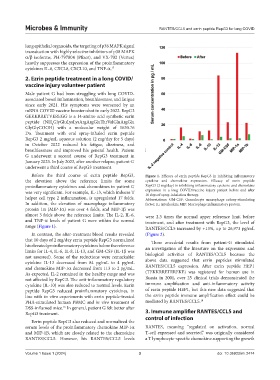
              Before  the  third  course  of  ezrin  peptide  RepG3,   Figure  1. Efficacy of ezrin peptide RepG3 in inhibiting inflammatory
            the  elevation  above  the  reference  limits  for  some   cytokine  and  chemokine  expression.  Efficacy  of  ezrin  peptide
            proinflammatory cytokines and chemokines in patient G   RepG3 (2 mg/day) in inhibiting inflammatory cytokine and chemokine
            was very significant. For example, IL-13, which induces T   expression in a long COVID/vaccine injury patient  before and after
                                                               10 days of spray-inhalation therapy.
            helper cell type 2 inflammation, is upregulated 17 folds.   Abbreviations: GM-CSF: Granulocyte macrophage colony-stimulating
            In  addition,  the elevation  of  macrophage inflammatory   factor; IL: Interleukin; MIP: Macrophage inflammatory protein.
            protein 1α (MIP-1α) was over 4 folds, and MIP-1β was
            almost 3 folds above the reference limits. The IL-2, IL-6,   were  2.3  times the normal upper  reference limit before
            and TNF-α levels of patient G were within  the normal   treatment, and after treatment with RepG3, the level of
            range (Figure 1).                                  RANTES/CCL5 increased by +13%, up to 26,973 pg/mL
              In contrast, the after-treatment blood results revealed   (Figure 2).
            that 10 days of 2 mg/day ezrin peptide RepG3 normalized   These  anecdotal  results  from  patient-G  stimulated
            his elevated proinflammatory cytokines below the reference   an investigation of the literature on the expression and
            limits for IL-4, IL-6, IL-8, IL-13, and GM-CSF (IL-1β was
            not assessed). Some of the reductions were remarkable:   biological activities of RANTES/CCL5 because the
            cytokine IL-13 decreased from 84  pg/mL to 4  pg/mL   above data suggested that ezrin peptides stimulated
            and chemokine MIP-1α decreased from 113 to 2 pg/mL.   RANTES/CCL5 expression. After ezrin peptide HEP1
            As expected, IL-2 remained in the healthy range and was   (TEKKRRETEREKE)  was  registered  for human use  in
            not affected by RepG3. The anti-inflammatory regulatory   Russia in 2001, over 25 clinical trials demonstrated the
            cytokine (IL-10) was also reduced to normal levels. Ezrin   immune amplification and anti-inflammatory activity
            peptide RepG3 reduced proinflammatory cytokines, in   of ezrin peptide HEP1, but this new data suggested that
            line with in vitro experiments with ezrin peptide-treated   the  ezrin  peptide  immune  amplification  effect  could  be
            PHA-stimulated human PBMC and in vivo treatment of   mediated by RANTES/CCL5. 18
            DSS-inflamed mice.  In general, patient G felt better after
                            18
            RepG3 treatment.                                   3. Immune amplifier RANTES/CCL5 and
                                                               control of infection
              Ezrin peptide RepG3 also reduced and normalized the
            serum levels of the proinflammatory chemokine MIP-1α   RANTES, meaning “regulated on activation, normal
            and MIP-1β, which are closely related to the chemokine   T-cell expressed and secreted,” was originally considered
            RANTES/CCL5. However, his RANTES/CCL5  levels      a T lymphocyte-specific chemokine supporting the growth


            Volume 1 Issue 1 (2024)                         3                                doi: 10.36922/mi.2474

