


Page 43 - MI-1-2
P. 43
Microbes & Immunity                                                 Host receptors in immunogenic cell death


            a phenomenon referred to as lysosomal membrane     In addition, the accumulation of ROS produced during
            permeabilization (LMP).  The occurrence of LMP     intracellular bacterial infections causes oxidative stress and
                                 138
            is accompanied by the release of cathepsins from the   damages to lysosomal membrane proteins. For instance,
            lysosomal lumen, which leads to the cleavage of Bid to   infections by  Shigella  or  Chlamydia are detected by
                                                                                 143
            generate tBid.  tBid then forms pores in mitochondria   NLR family member X1 (NLRX1), which localizes to
                       139
            to trigger the release of cytochrome c (Cyto c), which   mitochondria and induces  the production of ROS,
                                                                                                            144
            activates the classic apoptotic pathway that ultimately leads   resulting in subsequent lysosomal cell death. (4) An earlier
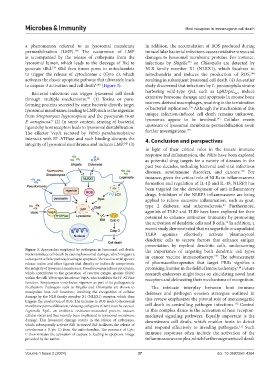
            to caspase-3 activation and cell death 9,140  (Figure 3).  study discovered that infections by L. pneumophila strains
              Bacterial infections can trigger lysosomal cell death   harboring wild-type  rpsL such as Lp02rpsL  induce
                                                                                                     WT
            through  multiple  mechanisms:   (1)  Toxins  or  pore-  extensive lysosome damage and apoptosis in mouse bone
                                      141
            forming proteins secreted by some bacteria directly target   marrow-derived macrophages, resulting in the termination
                                                                                 138
            lysosomal membranes, leading to LMP, such as the nigericin   of bacterial replication.  Although the mechanism of this
            from Streptomyces hygroscopicus and the pyocyanin from   unique  infection-induced  cell  death  remains  unknown,
                                                                                             145
            P. aeruginosa.   (2) In some context, sensing of bacterial   lysosomes appear to be involved.  Cellular events
                       9
            ligands by host receptors leads to lysosomal destabilization.   upstream of lysosomal membrane permeabilization await
                                                                                145
            The effector VepA secreted by  Vibrio parahaemolyticus   further investigations.
            interacts with H -ATPase and such binding disrupts the   4. Conclusion and perspectives
                         +
            integrity of lysosomal membranes and induces LMP.  (3)
                                                      142
                                                               In light of their critical roles in the innate immune
                                                               response and inflammation, the PRRs have been explored
                                                               as  potential  drug  targets  for  a  variety  of  diseases  in  the
                                                               past two decades, including bacterial and viral infectious
                                                               diseases, autoimmune disorders, and cancers.  For
                                                                                                       146
                                                               instance, given the critical role of NLRs in inflammasome
                                                               formation and regulation of IL-1β and IL-18, NLRP3 has
                                                               been targeted for the development of anti-inflammatory
                                                               drugs. Inhibitors of the NLRP3 inflammasome are being
                                                               applied to relieve excessive inflammation, such as gout,
                                                               type  2  diabetes,  and  atherosclerosis.   Furthermore,
                                                                                                62
                                                               agonists of TLR7 and TLR9 have been explored for their
                                                               potential to enhance antitumor immunity by promoting
                                                               the activation of dendritic cells and B cells.  In addition, a
                                                                                                 26
                                                               recent study demonstrated that nanoparticle-encapsulated
                                                               TLR9   agonists  effectively  activate  plasmacytoid
                                                               dendritic  cells  to  secrete  factors  that  enhance  antigen
                                                               presentation  by  myeloid  dendritic  cells,  underscoring
            Figure 3. Approaches employed by pathogens in lysosomal cell death.   the importance  of targeting both dendritic cell types
            Bacteria induce cell death by causing lysosomal damage, which triggers a   in cancer vaccine immunotherapy.  The advancement
                                                                                            147
            subsequent cellular pathway leading to apoptosis. Various bacterial species
            release toxins and other ligands that directly or indirectly compromise   of pharmacotherapeutics that target PRRs signifies a
                                                                                                      148
            the integrity of lysosomal membranes. Pseudomonas produces pyocyanin,   promising frontier in the field of immunotherapy.  Future
            which contributes to the generation of reactive oxygen species (ROS)   research endeavors might focus on elucidating novel host
            within the cell. Vibrio species release VepA, which inhibits the H  ATPase   receptors and delineating their mechanisms of recognition.
                                                     +
            function. Streptomyces contributes nigericin as part of its pathogenicity
            mechanism. Pathogens such as  Shigella and  Chlamydia are shown to   The intricate interplay between host immune
            manipulate host cell functions, involving the recognition of cellular   defenses and pathogen evasion strategies outlined in
            damage by the NLR family member X1 (NLRX1) receptor, which then   this review emphasizes the pivotal role of immunogenic
            triggers the production of ROS. The increase in ROS leads to lysosomal                   112
            membrane permeabilization, releasing cathepsins (CtsB) into the cytosol.   cell death in controlling pathogen infections.  Central
            Legionella  RpsL, an antibiotic resistance-associated protein, induces   to this complex dance is the activation of host receptor-
            cellular stress and has recently been implicated in lysosomal membrane   mediated  signaling pathways.  Equally important  is the
            damage. This lysosomal damage results in the release of cathepsins,   downstream cell death, which enables hosts to detect
            which subsequently activate Bid. Activated Bid facilitates the release of   and respond effectively to invading pathogens.  Such
                                                                                                       112
            cytochrome c  (Cyto  C) from the  mitochondria.  The  presence  of Cyto
            C then initiates the activation of caspase 3, leading to apoptosis. Image   immune  responses  often  include  the  activation  of  the
            provided by the author.                            inflammasome complex, which further augments cell death

            Volume 1 Issue 2 (2024)                         37                               doi: 10.36922/mi.4264

