


Page 100 - MI-2-2
P. 100
Microbes & Immunity Big data and DNN-based DTI model in CHP
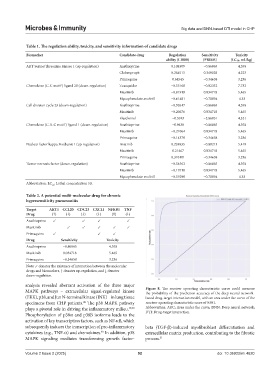
Table 1. The regulation ability, toxicity, and sensitivity information of candidate drugs
Biomarker Candidate drug Regulation Sensitivity Toxicity
ability (L1000) (PRISM) (LC50, mL/kg)
AKT Serine/Threonine Kinase 1 (up-regulation) Azathioprine 0.108309 −0.86865 4.558
Clobenpropit 0.264513 0.349028 4.223
Primaquine 0.64545 −0.34658 3.236
Chemokine (C-C motif) ligand 20 (down-regulation) Zosuquidar −0.55168 −0.02332 7.732
Masitinib −0.81919 0.034718 5.465
Mycophenolate-mofetil −0.61481 −0.70094 4.33
Cell division cycle 23 (down-regulation) Azathioprine −0.92617 −0.86865 4.558
Masitinib −0.20676 0.034718 5.465
Elesclomol −0.5743 −2.86051 4.321
Chemokine (C-X-C motif) ligand 1 (down-regulation) Azathioprine −0.9438 −0.86865 4.558
Masitinib −0.21064 0.034718 5.465
Primaquine −0.14379 −0.34658 3.236
Nuclear factor kappa B subunit 1 (up-regulation) Imatinib 0.224935 −0.80213 5.419
Masitinib 0.21467 0.034718 5.465
Primaquine 0.310101 −0.34658 3.236
Tumor necrosis factor (down-regulation) Azathioprine −0.54562 −0.86865 4.558
Masitinib −0.19718 0.034718 5.465
Mycophenolate-mofetil −0.59299 −0.70094 4.33
Abbreviation: LC : Lethal concentration 50.
50
Table 2. A potential multi‑molecular drug for chronic
hypersensitivity pneumonitis
Target AKT1 CCL20 CDC23 CXCL1 NFKB1 TNF
Drug () () () () () ()
Azathioprine ✓ ✓ ✓ ✓
Masitinib ✓ ✓ ✓ ✓ ✓
Primaquine ✓ ✓ ✓
Drug Sensitivity Toxicity
Azathioprine −0.86865 4.558
Masitinib 0.034718 5.465
Primaquine −0.34658 3.236
Note: ✓ denotes the existence of interaction between the molecular
drugs and biomarkers, ↑ denotes up-regulation, and ↓ denotes
down-regulation.
analysis revealed aberrant activation of the three major
MAPK pathways – extracellular signal-regulated kinase Figure 8. The receiver operating characteristic curve could measure
the probability of the prediction accuracy of the deep neural network-
(ERK), p38, and Jun N-terminal kinase (JNK) – in lung tissue based drug-target interaction model, with an area under the curve of the
specimens from CHP patients. The p38 MAPK pathway receiver operating characteristic score of 0.981.
28
plays a pivotal role in driving the inflammatory milieu. 29,30 Abbreviation: AUC: Area under the curve; DNN: Deep neural network;
Phosphorylation of p38α and p38β isoforms leads to the DTI: Drug-target interaction.
activation of key transcription factors, such as NF-κB, which
subsequently induces the transcription of pro-inflammatory beta (TGF-β)-induced myofibroblast differentiation and
cytokines (e.g., TNF-α) and chemokines. In addition, p38 extracellular matrix production, contributing to the fibrotic
30
MAPK signaling mediates transforming growth factor- process. 31
Volume 2 Issue 2 (2025) 92 doi: 10.36922/mi.4620

