


Page 136 - MI-2-2
P. 136
Microbes & Immunity                                Establishment of a novel anti-human CCR8 monoclonal antibody


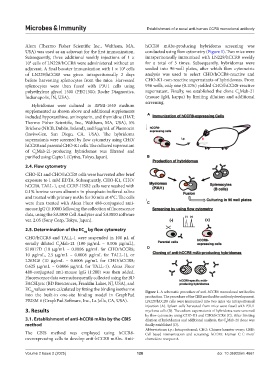
            Alum (Thermo Fisher Scientific Inc., Waltham, MA,   hCCR8  mAbs-producing hybridoma  screening  was
            USA) was used as an adjuvant for the first immunization.   conducted using flow cytometry (Figure 1). Two mice were
            Subsequently, three additional weekly injections of 1 ×   intraperitoneally immunized with LN229/hCCR8 weekly
            10  cells of LN229/hCCR8 were administered without an   for a total of 5  times. Subsequently, hybridomas were
              8
                                                      8
            adjuvant. A final booster immunization with 1 × 10  cells   seeded into 96-well plates, after which flow cytometric
            of LN229/hCCR8 was given intraperitoneally 2  days   analysis  was used to  select CHO/hCCR8-reactive and
            before  harvesting  splenocytes  from  the mice. Harvested   CHO-K1-non-reactive supernatants of hybridomas. From
            splenocytes were then fused with P3U1  cells using   956 wells, only one (0.10%) yielded CHO/hCCR8-reactive
            polyethylene glycol 1500 (PEG1500; Roche Diagnostics,   supernatant. Finally, we established the clone C Mab-21
                                                                                                      8
            Indianapolis, IN, USA).                            (mouse IgM, kappa) by limiting dilution and additional
                                                               screening.
              Hybridomas were cultured in RPMI-1640 medium
            supplemented as shown above and additional supplements
            included hypoxanthine, aminopterin, and thymidine (HAT;   A
            Thermo Fisher Scientific, Inc., Waltham, MA, USA), 5%
            Briclone (NICB, Dublin, Ireland), and 5 μg/mL of Plasmocin
            (InvivoGen, San  Diego,  CA,  USA).  The  hybridoma
            supernatants were screened by flow cytometry using CHO/
            hCCR8 and parental CHO-K1 cells. The cultured supernatant
            of C Mab-21-producing hybridomas was filtrated and
                8
            purified using Capto L (Cytiva, Tokyo, Japan).      B
            2.4. Flow cytometry

            CHO-K1 and CHO/hCCR8 cells were harvested after brief
            exposure to 1 mM EDTA. Subsequently, CHO-K1, CHO/
            hCCR8, TALL-1, and CCRF-HSB2 cells were washed with
            0.1% bovine serum albumin in phosphate-buffered saline
            and treated with primary mAbs for 30 min at 4°C. The cells
            were then treated with Alexa Fluor 488-conjugated anti-  C
            mouse IgG (1:1000) following the collection of fluorescence
            data, using the SA3800 Cell Analyzer and SA3800 software
            ver. 2.05 (Sony Corp, Tokyo, Japan).
            2.5. Determination of the EC  by flow cytometry
                                     50
            CHO/hCCR8  and  TALL-1  were  suspended  in  100  μL  of
            serially diluted C Mab-21  (100  μg/mL – 0.006  μg/mL),
                          8
            S19017D (10  μg/mL  – 0.0006  μg/mL  for CHO/hCCR8;   D
            10  μg/mL, 2.5  μg/mL – 0.0006  μg/mL for TALL-1), or
            L263G8  (10  μg/mL – 0.0006  μg/mL for CHO/hCCR8;
            0.625  μg/mL – 0.0006  μg/mL for TALL-1). Alexa Fluor
            488-conjugated anti-mouse IgG (1:200) was then added.
            Fluorescence data were subsequently collected using the BD
            FACSLyric (BD Biosciences, Franklin Lakes, NJ, USA), and
            EC values were calculated by fitting the binding isotherms   Figure 1. A schematic procedure of anti-hCCR8 monoclonal antibodies
              50
            into the built-in one-site binding model in GraphPad   production. The procedure of the CBIS method for antibody development.
            PRISM 6 (GraphPad Software, Inc., La Jolla, CA, USA).  LN229/hCCR8 cells were immunized into two mice via intraperitoneal
                                                               injection (A). Spleen cells harvested from mice were fused with P3U1
            3. Results                                         myeloma cells (B). The culture supernatants of hybridoma were screened
                                                               by flow cytometry using CHO-K1 and CHO/hCCR8 (C). After limiting
            3.1. Establishment of anti-hCCR8 mAbs by the CBIS   dilution of hybridomas and additional analysis, the C Mab-21 clone was
            method                                             finally established (D).          8
                                                               Abbreviations: i.p.: Intraperitoneal; CHO: Chinese hamster ovary; CBIS:
            The CBIS method was employed using hCCR8-          Cell-based immunization and screening; hCCR8: Human C-C motif
            overexpressing cells to develop anti-hCCR8 mAbs. Anti-  chemokine receptor-8.


            Volume 2 Issue 2 (2025)                        128                               doi: 10.36922/mi.4661

