


Page 31 - MI-2-2
P. 31
Microbes & Immunity                                                     Genetic therapy with HSV-1 vectors


            virus-independent packaging system, its helper function is   non-replicating and unintegrated vector DNA in host cells,
            provided by a series of cosmids with overlapping regions   and  whether  amplicon  vectors can be  widely used must
            carrying the HSV-1 genome (with the pac packaging signal   overcome these difficulties. The amplicon production and
            removed).   Recently,  bacterial  artificial  chromosome   purification procedures also need further improvement.
                    36
            (BAC) technology has been used to clone the entire HSV-1   At present, we still cannot fully understand which viral
            genome lacking the pac signal into the BAC, which can   proteins are involved in regulating gene expression, thus
            efficiently replicate DNA in bacteria and effectively exert the   directly affecting amplicon carrier gene expression.
            function of HSV-1 after entering cells, greatly simplifying
            the system and significantly improving its efficiency.    4.2. Replication-deficient vector
                                                         37
            There is also a Cre/loxP site-specific recombination system   Replication-deficient  vectors  selectively  mutate  or  delete
            that is missing the packaging signal for helper viruses   some genes essential for growth in cell culture so that the
            and replicates amplicons equally efficiently.  Therefore,   virus cannot replicate in normal cells unless complemented
                                                38
            amplicon vectors have emerged as very useful tools in   in trans in transformed cell lines. HSV-1 encodes at least
            neurological studies. 32                           84 genes, half of which are non-essential. Close to 30 kb in
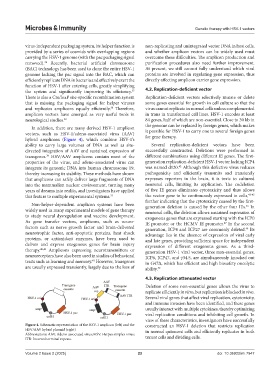
              In addition, there are many derived HSV-1 amplicon   the genome can be replaced by foreign genes, which makes
            vectors,  such  as  HSV-1/adeno-associated  virus  (AAV)   it possible for HSV-1 to carry one to several foreign genes
            hybrid amplicons (Figure  4), which combine HSV-1’s   for gene therapy.
            ability to carry large volumes of DNA as well as site-  Several replication-deficient vectors have been
            directed integration of AAV and sustained expression of   successfully constructed. Deletions were performed in
            transgenes.  HSV/AAV  amplicons contain most  of the   different combinations using different IE genes. The first-
                     39
            properties of the virus, and adeno-associated virus can   generation replication-deficient HSV-1 vector lacking ICP4
                                                                             42
            integrate its genomic DNA into human chromosome 19,   was named d120.  Although this defective virus reduces
            thereby increasing its stability. These methods have shown   pathogenicity and efficiently transmits and transiently
            that amplicons can safely deliver large fragments of DNA   expresses reporters in the brain, it is toxic to cultured
            into the mammalian nuclear environment, turning many   neuronal cells, limiting its application. The codeletion
            years of dreams into reality, and investigators have applied   of five IE genes eliminates cytotoxicity and thus allows
            this feature to multiple experimental systems. 32  the vector gene to be continuously expressed in cells, 43-45
                                                               further indicating that the cytotoxicity caused by the first-
              Non-helper-dependent amplicon systems have been   generation deletion is caused by the other four IEs.  In
                                                                                                          46
            widely used in many experimental models of gene therapy   neuronal cells, the deletion allows sustained expression of
            to study neural dysregulation and vaccine development.   exogenous genes that are expressed starting with the ICP0
            As gene transfer vectors, amplicons, such as neuro-  IE promoter or the HCMV IE promoter.  In the second
                                                                                                47
            factors such as nerve growth factor and brain-delivered   generation, ICP4 and ICP27 are commonly deleted.  Its
                                                                                                          48
            neurotrophic factor, anti-apoptotic proteins, heat shock   advantage lies in the absence of expression of viral early
            proteins,  or  antioxidant  enzymes,  have  been  used  to   and late genes, providing sufficient space for independent
            deliver and express exogenous genes for brain injury   expression of different exogenous genes. As a third-
            therapy. 40,41  Amplicons expressing neurotransmitters or   generation HSV-1 viral vector, three non-essential genes,
            neuroreceptors have also been used in studies of behavioral   ICP6, ICP47, and γ34.5, are simultaneously knocked out
            traits such as learning and memory.  However, transgenes   in G47∆, which has efficient and high biosafety oncolytic
                                        40
            are usually expressed transiently, largely due to the loss of   ability. 49
                                                               4.3. Replication attenuated vector
                                                               Deletion of some non-essential genes allows the virus to
                                                               replicate efficiently in vitro, but replication is blocked in vivo.
                                                               Several viral genes that affect viral replication, cytotoxicity,
                                                               and immune invasion have been identified, and these genes
                                                               usually interact with multiple cytokines, thereby optimizing
                                                               viral replication conditions and inhibiting cell growth. In
                                                               view of these characteristics, investigators have successfully
            Figure 4. Schematic representation of the HSV-1 amplicon (left) and the   constructed an HSV-1 deletion that restricts replication
            HSV/AAV hybrid plasmid (right)                     in normal quiescent cells and efficiently replicates in both
            Abbreviations: AAV: Adeno-associated virus; HSV: Herpes simplex virus;
            ITR: Inverted terminal repeats.                    tumor cells and dividing cells.


            Volume 2 Issue 2 (2025)                         23                               doi: 10.36922/mi.7947

