


Page 55 - MI-2-2
P. 55
Microbes & Immunity                                                   Role of SRCR proteins in inflammation


            glycoprotein primarily expressed by macrophages,   documented, and its presence in the lungs, saliva, intestinal
            interacts with various types of bacteria and viruses. 6  surfaces, amniotic fluid, and newborn meconium indicates
                                                                                                             6
              Although the anti-inflammatory potential of individual   its critical role in regulating inflammatory responses.
            SRCR proteins has been recognized for years, their   DMBT1 enhances classical complement pathway
            collective significance in inflammation modulation has   activation by interacting with complement proteins,
            often been overlooked. Emerging evidence suggests   particularly C1q, thereby shaping an anti-inflammatory
                                                                              7
            that most, if not all, SRCR proteins possess crucial anti-  immune  response.   DMBT1  significantly  influences  the
            inflammatory properties that may operate independently   production and secretion of pro-inflammatory cytokines,
            or alongside microbial targeting. These insights underscore   such  as  interleukin  (IL)-6,  aiding  in  the  regulation of
                                                                                  8
            the important functions of SRCR proteins in controlling   inflammatory processes.  Furthermore, it has been shown
            inflammation and facilitating tissue repair, revealing their   to  promote vascular  endothelial  growth  factor  (VEGF)
            multifaceted roles in immune defense and the resolution of   while suppressing IL-6 production in alveolar tissues,
            inflammatory responses.                            indicating its capacity to mediate the transition from
                                                               inflammation to tissue regeneration.  This dual capability
                                                                                            8
            2. Circulating SRCRs                               establishes  DMBT1 as a  valuable clinical marker for
            Soluble SRCRs play a pivotal role in modulating    managing inflammatory conditions.
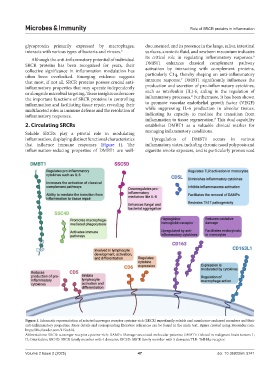
            inflammation, displaying distinct functional characteristics   Upregulation  of  DMBT1  occurs  in  various
            that influence immune responses (Figure  1). The   inflammatory states, including chronic nasal polyposis and
            inflammation-reducing properties of DMBT1 are well-  cigarette smoke exposure, and is particularly pronounced


            Figure 1. Schematic representation of selected scavenger receptor cysteine-rich (SRCR) superfamily soluble and membrane-anchored members and their
            anti-inflammatory properties. More details and corresponding literature references can be found in the main text. Figure created using Biorender.com.
            https://BioRender.com/k15w818.
            Abbreviations: SRCR: scavenger receptor cysteine-rich; DAMPs: Damage-associated molecular patterns; DMBT1: Deleted in malignant brain tumors 1;
            IL: Interleukin; SSC4D: SRCR family member with 4 domains; SSC5D: SRCR family member with 5 domains; TLR: Toll-like receptor.

            Volume 2 Issue 2 (2025)                         47                               doi: 10.36922/mi.5741

