


Page 180 - MI-2-3
P. 180
Microbes & Immunity                                     A novel anti-EphB2 monoclonal antibody for flow cytometry


                        A


                       B


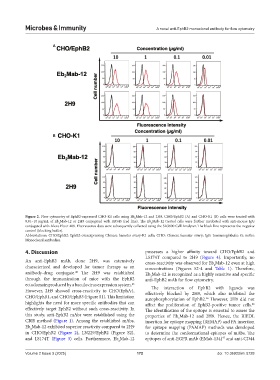
            Figure 2. Flow cytometry of EphB2-expressed CHO-K1 cells using Eb Mab-12 and 2H9. CHO/EphB2 (A) and CHO-K1 (B) cells were treated with
                                                          2
            0.01–10  μg/mL of Eb Mab-12 or 2H9 conjugated with RB545 (red line). The Eb Mab-12 treated cells were further incubated with anti-mouse IgG
                          2
                                                                 2
            conjugated with Alexa Fluor 488. Fluorescence data were subsequently collected using the SA3800 Cell Analyzer. The black line represents the negative
            control (blocking buffer).
            Abbreviations: CHO/EphB2: EphB2-overexpressing Chinese hamster ovary-K1 cells; CHO: Chinese hamster ovary; IgG: Immunoglobulin G; mAbs:
            Monoclonal antibodies.
            4. Discussion                                      possesses a higher affinity toward CHO/EphB2 and
                                                               LS174T compared to 2H9 (Figure  4). Importantly, no
            An anti-EphB2 mAb, clone 2H9, was extensively      cross-reactivity was observed for Eb Mab-12 even at high
            characterized  and  developed  for  tumor  therapy  as  an   concentrations (Figures S2-4 and  Table 1). Therefore,
                                                                                            2
            antibody-drug conjugate.  The 2H9 was established   Eb Mab-12 is recognized as a highly sensitive and specific
                                 46
                                                                 2
            through  the  immunization  of  mice  with  the  EphB2   anti-EphB2 mAb for flow cytometry.
            ectodomain produced by a baculovirus expression system.
                                                         46
                                                                 The interaction of EphB2 with ligands was
            However, 2H9 showed cross-reactivity to CHO/EphA4,   effectively blocked by 2H9, which also inhibited the
            CHO/EphB1, and CHO/EphB3 (Figure S1). This limitation   autophosphorylation of EphB2.  However, 2H9 did not
                                                                                         46
            highlights the need for more specific antibodies that can   affect the proliferation of EphB2-positive tumor cells.
                                                                                                            46
            effectively target EphB2 without such cross-reactivity. In   The identification of the epitope is essential to assess the
            this study, anti-EphB2 mAbs were established using the   properties  of  Eb Mab-12  and  2H9.  Hence,  the  RIEDL
                                                                             2
            CBIS method (Figure  1). Among the established mAbs,   insertion for epitope mapping (REMAP) and PA insertion
            Eb Mab-12 exhibited superior reactivity compared to 2H9   for epitope mapping (PAMAP) methods was developed
              2
            in CHO/EphB2 (Figure  2), LN229/EphB2 (Figure S2),   to determine the conformational epitopes of mAbs. The
            and LS174T (Figure  3) cells. Furthermore, Eb Mab-12   epitopes of anti-EGFR mAb (EMab-134)  and anti-CD44
                                                                                                47
                                                   2
            Volume 2 Issue 3 (2025)                        172                               doi: 10.36922/mi.5728

