


Page 106 - MI-2-4
P. 106
Microbes & Immunity                                         Brachyspira pilosicoli novel outer membrane proteins


               A                    B                    C                D                 E


                 F                  G                 H                  I                 J


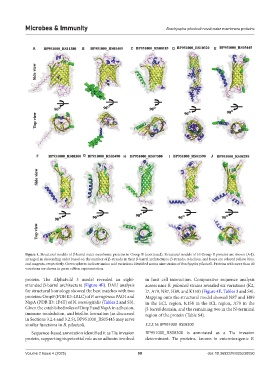
            Figure 4. Structural models of β-barrel outer membrane proteins in Group B (continued). Structural models of 10 Group B proteins are shown (A-J),
            arranged in descending order based on the number of β-strands in their β-barrel architectures. β-strands, α-helices, and loops are colored yellow, blue,
            and magenta, respectively. Green spheres indicate amino acid variations identified across nine strains of Brachyspira pilosicoli. Proteins with more than 40
            variations are shown in green ribbon representation.
            protein.  The  AlphaFold  3  model  revealed  an  eight-  in host cell interaction. Comparative sequence analysis
            stranded β-barrel architecture (Figure 4E). DALI analysis   across nine B. pilosicoli strains revealed six variations (K2,
            for structural homology showed the best matches with two   I7, A79, N87, H89, and K158) (Figure 4E, Tables 3 and S4).
            proteins: OmpF (PDB ID: 4RLC) of P. aeruginosa PAO1 and   Mapping onto the structural model showed N87 and H89
            NspA (PDB ID: 1P4T) of N. meningitidis (Tables 2 and S3).   in the ECL region, K158 in the ICL region, A79 in the
            Given the established roles of OmpF and NspA in adhesion,   β-barrel domain, and the remaining two in the N-terminal
            immune modulation, and biofilm formation (as discussed   region of the protein (Table S4).
            in Sections 3.2.4 and 3.2.5), BP951000_RS05445 may serve
            similar functions in B. pilosicoli.                3.2.2.16. BP951000_RS08300
              Sequence-based annotation identified it as Tia invasion   BP951000_RS08300  is annotated as  a  Tia  invasion
            protein, supporting its potential role as an adhesin involved   determinant. Tia  proteins,  known  in enterotoxigenic  E.


            Volume 2 Issue 4 (2025)                         98                           doi: 10.36922/MI025230050

