


Page 142 - MI-2-4
P. 142
Microbes & Immunity                                         Glioblastoma therapy: Immunotherapy and inhibitors


            tumor volume by total gross resection holds extremely low   5. Immunotherapy
            efficacy as a treatment option. Furthermore, in many cases,
            surgical intervention into the neocortex, basal ganglia, and   5.1. Mechanisms of immunosuppression in
            the brainstem is either unfeasible or comes at a significant   glioblastoma
            cost to quality of life. 26,27                     Over the past decade, our understanding of

              Following safe surgical resection of the tumor, patients   immunosurveillance within the CNS has substantially
            begin  a radiotherapeutic  intervention  concomitant   shifted. The notion that the brain and spinal cord are
                                            ®
            with temozolomide (TMZ) (Temodar ), an alkylating   immune-privileged has been radically discredited by the
            chemotherapeutic agent. Post-radiotherapy, patients are   substantial literature demonstrating a robust immune
                                                         28
            given adjuvant TMZ alone as a course of chemotherapy.    response generated by B- and T-cell adaptive immunogens
            Other chemotherapeutic agents that have shown moderate   during inflammation-derived conditions such as
            efficacy are anti-angiogenic agents such as bevacizumab   common intracerebral infections, multiple sclerosis, and
            (an  anti-vascular  endothelial  growth  factor  [VEGF]   encephalitis. 33,34  This emerging shift in paradigm to view
            monoclonal antibody) and gefitinib and erlotinib (anti-  the brain as immunologically robust, with distinct and
            epidermal growth factor receptor [EGFR] tyrosine kinase   active lymphatic channels capable of priming B-  and
            inhibitors [TKIs]). 29,30                          T-lymphocytes, presents a promising venture in developing
                                                               novel immunotherapeutics for the treatment of GBM.
                                                                                                            35
              Alternating electric field therapy, also referred to as   Unlike  chemotherapy, immunotherapy carries non-
            TTF, is an emergent FDA-approved therapy, serving as a   existent cellular and genetic toxicity, low side effects, and a
            concurrent treatment option for newly diagnosed GBM or   highly selective, patient-stratified therapeutic strategy that
                                                         ®
            recurrent GBM alongside TMZ. The TTF device, Optune ,   counteracts the highly heterogeneous genome of GBM
            works by a battery-powered device that delivers alternating   cells.
            electrical fields of low intensity to disrupt cell division and
            cause eventual apoptosis. TTF is a relatively safe mode of   Local and systemic immunosuppression is a consistent
            treatment as the induction frequency can be selectively   characteristic of GBM, recapitulated by immunosuppressive
            adjusted to target GBM tumor cells, characterized by rapid   factors present in cervical lymph nodes, blood, bone marrow,
            cell divisions. 31,32  The major challenges in the treatment of   and spleen. Common mechanisms of immunosuppression
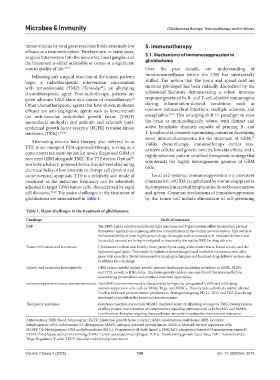
            glioblastoma are summarized in Table 1.            by  the  tumor  cell  include  elimination  of  self-presenting

            Table 1. Major challenges in the treatment of glioblastoma

            Challenge                                                Mode of resistance
            BBB                            The BBB’s highly selective endothelial tight junctions and P-glycoprotein efflux transporters prevent
                                           therapeutic agents from achieving effective concentrations in the central nervous system. This restricts
                                           the bioavailability of even highly potent drugs. Strategies such as nanoparticle-mediated delivery and
                                           focused ultrasound are being investigated to transiently disrupt the BBB for drug delivery.
            Tumor infiltration and recurrence  Glioblastoma cells invade healthy brain parenchyma using white matter tracts, blood vessels, and the
                                           leptomeningeal space. This results in indistinct tumor margins and inevitable recurrence even after
                                           gross total resection. Novel intraoperative imaging techniques and localized drug delivery systems aim
                                           to address this challenge.
            Genetic and molecular heterogeneity  GBM tumors exhibit patient-specific genomic landscapes, including mutations in EGFR, PTEN,
                                           and TP53, as well as IDH status. This heterogeneity renders one-size-fits-all therapies ineffective,
                                           necessitating personalized and stratified treatment approaches.
            Immunosuppressive tumor microenvironment  The GBM microenvironment is characterized by hypoxia, upregulated VEGF, and infiltrating
                                           immunosuppressive cells such as TAMs, Tregs, and MDSCs. These factors collectively inhibit effector
                                           T-cell activity and promote tumor proliferation. Strategies targeting PD-L1, IDO, and TGF-β are being
                                           developed to modulate the tumor microenvironment.
            Therapeutic resistance         Resistance mechanisms include MGMT-mediated repair of alkylating damage by TMZ, overexpression
                                           of efflux pumps, and activation of compensatory signaling pathways such as PI3K/AKT and MAPK.
                                           Combination therapies targeting these pathways are under investigation to overcome resistance.
            Abbreviations: BBB: Blood-brain barrier; EGFR: Epidermal growth factor receptor; GBM: Glioblastoma multiforme; IDH: Isocitrate
            dehydrogenase; IDO: Indoleamine 2,3-dioxygenase; MAPK: mitogen-activated protein kinase; MDSCs: Myeloid-derived suppressor cells;
            MGMT: O6-Methylguanine-DNA methyltransferase; PD-L1: Programmed cell death ligand 1; PI3K/AKT: phosphatidylinositol 3-kinase/protein kinase B;
            PTEN: Phosphatase and tensin homolog; TAMs: Tumor-associated macrophages; TGF-β: Transforming growth factor beta; TMZ: Temozolomide;
            Tregs: Regulatory T-cells; VEGF: Vascular endothelial growth factor.


            Volume 2 Issue 4 (2025)                        134                               doi: 10.36922/mi.5075

