


Page 153 - MI-2-4
P. 153
Microbes & Immunity                                                   A case of cutaneous Nocardia farcinica


            Nocardia farcinica  represents approximately 10% of
            nocardiosis cases.   N.  farcinica  is a culprit for primary
                          2
            cutaneous nocardiosis and resistant to several commonly
            used antibiotics. We present a rare case of post-operative
            cutaneous nocardiosis with delay in therapy resulting
            in  prolonged  non-healing  wound.  This  report  aims  to
            emphasize the necessity to execute proper diagnosis,
            treatment, and monitoring for patients with N. farcinica
            infection limited to the skin/soft tissue.

            2. Case presentation
            A 57-year-old female with non-healing wound presented
            to the infectious disease clinic. The patient has a history of
            insulin-dependent type 2 diabetes with hemoglobin A1c
            (HbA1c) of 10.8% and tobacco dependence. The patient
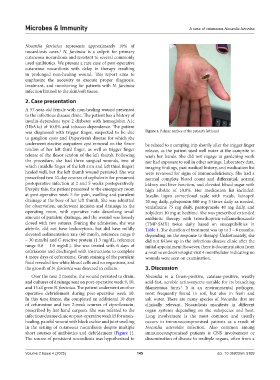
            was diagnosed with trigger finger, suspected to be due   Figure 1. Palmar surface of the patient’s left hand
            to ganglion cysts and Dupuytren’s disease for which she
            underwent elective outpatient cyst removal on the flexor   be related to a camping trip shortly after the trigger finger
            tendon of her left third finger, as well as trigger finger   release, as the patient used well water at the campsite to
            release of the flexor tendon of the left thumb. Following   wash  her  hands.  She  did  not  engage  in  gardening  work
            the procedure, she had three surgical wounds, two of   nor had exposure to soil in other settings. Laboratory data,
            which (middle finger of the left arm and left third finger)   imaging findings, past medical history, and medication list
            healed well, but the left thumb wound persisted. She was   were reviewed for signs of immunodeficiency. She had a
            prescribed two 10-day courses of cephalexin for presumed   normal  complete blood  count  and differential,  normal
            postoperative infection at 2 and 5 weeks postoperatively.   kidney and liver function, and elevated blood sugar with
            Despite this, the patient presented to the emergency room   high HbA1c of 10.8%. Her medication list included:
            at post-operative week 5 for pain, swelling and purulent   Insulin lispro correctional scale with meals, lisinopril
            drainage at the base of her left thumb. She was admitted   20 mg daily, gabapentin 600 mg 3 times daily as needed,
            for observation, underwent incision and drainage in the   venlafaxine  75  mg daily, pantoprazole  40  mg  daily, and
            operating room, with operative note describing small   zolpidem 10 mg at bedtime. She was prescribed extended
            amount of purulent drainage, and the wound was loosely   antibiotic  therapy  with  trimethoprim-sulfamethoxazole
            closed with two sutures. During the admission, she was   (TMP-SMX) twice daily based on susceptibilities in
            afebrile, did not have leukocytosis, but did have mildly   Table 1. The duration of treatment was up to 3 – 6 months,
            elevated sedimentation rate (60 mm/h, reference range 0   depending on the response to therapy. Unfortunately, she
            – 30 mm/h) and C-reactive protein (1.3 mg/dL, reference   did not follow up in the infectious disease clinic after the
            range 0.0 – 1.0  mg/dL). She was treated with 6  days of   initial appointment; however, there is documentation from
            ceftriaxone and discharged with instructions to complete   a routine endocrinologist visit 4 months later indicating no
            4 more days of cefuroxime. Gram staining of the purulent   wounds were seen on examination.
            fluid revealed few white blood cells and no organisms, and
            the growth of N. farcinica was detected in culture.  3. Discussion
              Over the next 2 months, the wound persisted to drain,   Nocardia  is a Gram-positive, catalase-positive, weakly
            and cultures of drainage sent on post-operative week 9, 10,   acid-fast, aerobic actinomycete notable for its branching
            and 13 all grew N. farcinica. The patient underwent another   filamentous form.  It is an environmental pathogen,
                                                                              3
            operative debridement during post-operative week 10.   most  frequently  found  in  soil,  but  also  in  fresh  and
            In this time frame, she completed an additional 10 days   salt water. There are many species of  Nocardia  that are
            of cefuroxime and two 2-week courses of ciprofloxacin,   clinically relevant. Nocardiosis manifests in different
            prescribed by her hand surgeon. She was referred to the   organ  systems  depending  on  the  subspecies  and  host.
            infectious disease clinic on post-operative week 15 for a non-  Lung involvement is the most common and usually
            healing, painful wound with black eschar and joint swelling   occurs in immunocompromised patients as a result of
            in the setting of cutaneous nocardiosis despite multiple   Nocardia asteroides  infection. Also common among
            short courses of antibiotics and debridement (Figure 1).   immunocompromised patients is CNS involvement or
            The source of persistent nocardiosis was hypothesized to   dissemination of disease to multiple organs, often from a


            Volume 2 Issue 4 (2025)                        145                               doi: 10.36922/mi.5189

