


Page 55 - MI-2-4
P. 55
Microbes & Immunity                                                              Management of obesity


            expenditure. Innovative approaches must be developed to   8.2. The functions of gut microbiota: Feeding
            determine whether gut bacteria influence thermogenesis   behavior and regulation of central appetite
            in humans.  Dysbiosis suppresses neuropeptide-related   The gut microbiota plays a critical part in regulating
                     52
            genes involved in energy homeostasis, including  GCG   central appetite and feeding behavior through multiple
            (encoding preproglucagon) and  BDNF (encoding brain-  mechanisms, as outlined in the following subsections.
            derived neurotrophic factor), and induces leptin resistance
            through suppressor of cytokine signaling-3, thereby   8.3. Bacterial metabolites and satiety
            exacerbating  obesity. The reduction of  L. paracasei   Certain bacteria (Bifidobacterium, Lactobacillus) produce
            removes  its  inhibition  of lipoprotein lipase, allowing   lactate, which supports neuronal activity and prolongs
            more triglycerides to be absorbed by adipocytes, thereby   satiety. SCFAs, such as acetate and butyrate, derived from
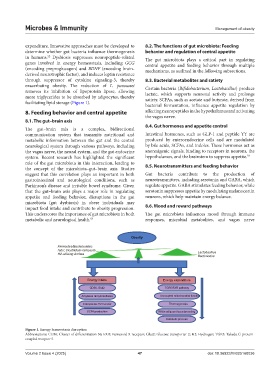
            facilitating lipid storage (Figure 1).
                                                               bacterial fermentation, influence appetite regulation by
            8. Feeding behavior and central appetite           affecting neuropeptides in the hypothalamus and activating
                                                               the vagus nerve.
            8.1. The gut–brain axis
                                                               8.4. Gut hormones and appetite control
            The gut–brain axis is a complex, bidirectional
            communication system that transmits nutritional and   Intestinal hormones, such as GLP-1 and peptide YY are
            metabolic information between the gut and the central   produced by enteroendocrine cells and are modulated
            neurological system through various pathways, including   by bile acids, SCFAs, and indoles. These hormones act as
            the vagus nerve, the neural system, and the gut endocrine   anorexigenic signals, binding to receptors in neurons, the
            system. Recent research has highlighted the significant   hypothalamus, and the brainstem to suppress appetite. 54
            role of the gut microbiota in this interaction, leading to   8.5. Neurotransmitters and feeding behavior
            the concept of the microbiota–gut–brain axis. Studies
            suggest that this correlation plays an important in both   Gut bacteria contribute to the production of
            gastrointestinal and neurological conditions, such as   neurotransmitters, including serotonin and GABA, which
            Parkinson’s disease and irritable bowel syndrome. Given   regulate appetite. GABA stimulates feeding behavior, while
            that the gut–brain axis plays a major role in regulating   serotonin suppresses appetite by modulating melanocortin
            appetite and feeding behavior, disruptions in the gut   neurons, which help maintain energy balance.
            microbiota (gut dysbiosis) in obese individuals may
            impact food intake and contribute to obesity progression.   8.6. Mood and reward pathways
            This underscores the importance of gut microbiota in both   The  gut microbiota influences  mood  through  immune
            metabolic and neurological health. 53              responses, microbial metabolites, and vagus nerve


                                                         Obesity

                          Firmicutes/Bacteriodetes
                          ratio; Clostridium ramosum                                 Lactobacillus
                          H2-utilizing Archea
                                                                                     Bacteriodes


                                      Energy intake                   Energy expenditure
                                       CD36, Glut2                     TGR5/FXR pathway
                                    Amylases /amylomaltases                Uncoupled mitochondrial function
                                    Interspecies H2 transfer                Thermogenesis
                                      SCFA production               White adipose tissue browning
                                                                        Catabolic process

            Figure 1. Energy homeostasis disruption
            Abbreviations: CD36: Cluster of differentiation 36; FXR: Farnesoid X receptor; Glut2: Glucose transporter 2; H2: Hydrogen; TGR5: Takeda G-protein-
            coupled receptor 5.


            Volume 2 Issue 4 (2025)                         47                           doi: 10.36922/MI025160036

