


Page 30 - OR-1-1
P. 30
1. Introduction                                   the tissue-engineered bone implants and the host bone
                                                              tissues by improving the osteogenic microenvironment for
            Bone defect repair and healing is a meticulously   osteoblast differentiation, infiltration, and metabolism. 1,11,12
            orchestrated physiological process that features a   Similarly, neural development and nerve invasion also
            complex interplay of diverse cells and signaling molecules   happen in skeleton formation processes, providing
            facilitating bone formation and wound healing. Such an   an ossification cue for activating osteogenic signaling
            intricate process involves many cell types and signaling   pathways and guiding osteoblast lineage progression. 13-17
            molecules orchestrated in specific transduction pathways,   Therefore, the interplay between bone and neural as well
            a complexity that, without proper understanding, leads   as vascular tissues attaches paramount importance to
            to failed attempts to develop optimal therapies and   bone development and regeneration. While extensive
            unsatisfactory repair outcomes in clinical practices.   researches have been conducted on vascularized bone
            Nowadays, autologous bone transplantation, as a gold-  regeneration, studies about the interaction between neural
            standard clinical treatment, has been widely employed for   development and osteogenesis processes, particularly
            bone regeneration but is limited by the low bone donor   innervated bone regeneration, remain relatively nascent
            availability and high infection risk, thereby resulting in   and underdeveloped.
            a lower success rate of transplantation than 90% in  the
            majority of reported cases.  Especially when the size   This review article illustrates the necessity and
                                    1-3
            of a lesion surpasses the innate regenerative capacity of   challenges associated with constructing innervated bone
            bone tissues, the process of bone repair is often impeded,   organoids from the view of nerve–bone crosstalk. With
            leading to delayed healing and demand for the exploration   a focus on innervated bone regeneration, this article first
            of novel methods, with osteoinductive biomaterials and   details interaction mechanisms between neurogenesis
            bone organoids emerging as novelty interventions at this   and skeleton development and summarizes several major
            juncture. 4                                       strategies for developing bioactive materials and tissue-
                                                              engineered bone organoids that osteogenesis could be
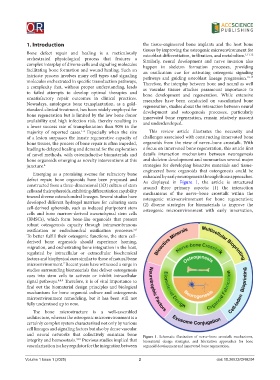
               Emerging as a promising avenue for refractory bone   enhanced by early neurogenesis through those approaches.
            defect  repair,  bone  organoids  have  been  proposed  and   As displayed in  Figure  1, the article is structured
            constructed from a three-dimensional (3D) culture of stem   around three primary aspects:  (1) the  interaction
            cells and their spheroids, exhibiting differentiation capability   mechanisms of the nerve–bone crosstalk within the
            toward diverse osteochondral lineages. Several studies have   osteogenic microenvironment for bone regeneration;
            developed different hydrogel matrixes for culturing stem   (2)  diverse  strategies  for  biomaterials  to  improve  the
            cell-derived spheroids, such as induced pluripotent stem   osteogenic microenvironment with early innervation,
            cells  and bone  marrow-derived mesenchymal  stem  cells
            (BMSCs),  which  form  bone-like  organoids  that present
            robust osteogenesis capacity through intramembranous
            ossification  or  endochondral  ossification  processes.
                                                          5,6
            To better fulfill their osteogenic functions, the stem cell-
            derived  bone  organoids  should  experience  homing,
            migration, and orchestrating bone integration in the host,
            regulated  by  intracellular  or  extracellular  biochemical
            factors and biophysical cues similar to those of natural bone
            microenvironment.  Recent years have witnessed a surge in
                            7
            studies surrounding biomaterials that deliver osteogenesis
            cues  into  stem cells to  activate or  inhibit  intracellular
            signal pathways. 4,8,9  Therefore, it is of vital importance to
            find out the biomaterial design principles and biological
            mechanisms for  bone organoid culture and  osteogenesis
            microenvironment remodeling, but it has been still not
            fully understood up to now.
               The bone microstructure is a well-assembled
            architecture, whereas the osteogenic microenvironment is a
            certainly complex system characterized not only by various
            cell lineages and signaling factors but also by dense vascular
            and neural networks that collectively maintain bone   Figure  1. Schematic illustration of nerve–bone crosstalk mechanisms,
            integrity and homeostasis.  Previous studies implied that   biomaterial design strategies, and fabrication approaches for bone
                                 9,10
            vascularization is a key regulator for the integration between   organoid development and innervated bone regeneration.

            Volume 1 Issue 1 (2025)                         2                                doi: 10.36922/OR8294

