


Page 39 - OR-1-1
P. 39
sodium alginate scaffolds, consequently promoting   of innervation by recruiting BMSCs and promoting their
            osteogenic differentiation of the BMSCs encapsulated   differentiation toward osteoblast lineage. With treatment
            in the bioprinted scaffolds, and improving bone   of the NSC-loading 3D-bioprinted constructs, for
            metabolism, homeostasis and neurovascularization. 110,127,128    example, a rat cranial bone defect repair results revealed
            Furthermore, the exosome-loaded 3D-bioprinted scaffolds   that blood vessel and nerve ingrowth were enhanced by
            can show a similar neuromodulatory effect, as evidenced   neuronal regeneration and axonal outgrowth in the bone
            by our recent research that following introduction into the   injury lesion, consequently providing an appropriate
            BMSC-laden  3D-bioprinted constructs, the SC-derived   microenvironment for guiding bone regeneration.
                                                                                                           131
            exosomes facilitated in vitro osteogenic differentiation of   Different from the NSC-laden 3D-bioprinted constructs,
            the BMSCs and  in vivo bone regeneration with elevated   the SCs and the BMSCs are often printed into the
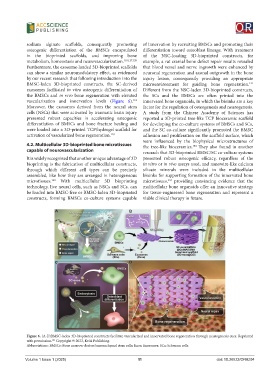
            vascularization and innervation levels (Figure  6).    innervated bone organoids, in which the bioinks are a key
                                                          118
            Moreover, the exosomes derived from the neural stem   factor for the regulation of osteogenesis and neurogenesis.
            cells (NSCs) that were activated by traumatic brain injury   A  study from the Chinese Academy of Sciences has
            presented robust capacities in accelerating osteogenic   reported a 3D-printed tree-like TCP bioceramic scaffold
            differentiation of BMSCs and bone fracture healing and   for developing the co-culture systems of BMSCs and SCs,
            were loaded into a 3D-printed TCP/hydrogel scaffold for   and the SC co-culture significantly promoted the BMSC
            activation of vascularized bone regeneration. 129  adhesion and proliferation on the scaffold surface, which
                                                              were influenced by the biophysical microstructures of
            4.2. Multicellular 3D-bioprinted bone microtissues   the tree-like bioceramics.  They also found in another
                                                                                   132
            capable of neurovascularization                   research that 3D-bioprinted BMSC/SC co-culture systems
            It is widely recognized that another unique advantage of 3D   presented robust osteogenic efficacy, regardless of the
            bioprinting is the fabrication of multicellular constructs,   in vitro or in vivo assays used, and nanowire-like calcium
            through which different cell types can be precisely   silicate minerals were included in the multicellular
            assembled, like how they are arranged in heterogeneous   bioinks for supporting formation of the innervated bone
            microtissues.   With  multicellular  3D  bioprinting   microtissues,  providing convincing evidence that the
                       130
                                                                        133
            technology, live neural cells, such as NSCs and SCs, can   multicellular bone organoids offer an innovative strategy
            be loaded into BMSC-free or BMSC-laden 3D-bioprinted   for tissue-engineered bone regeneration and represent a
            constructs,  forming  BMSCs  co-culture  systems  capable   viable clinical therapy in future.

                         A                              B


                        C C                             D  D


            Figure 6. (A-D)BMSC-laden 3D-bioprinted constructs facilitate vascularized and innervated bone regeneration through neurogenesis cues. Reprinted
            with permission.  Copyright © 2023, KeAi Publishing.
                       121
            Abbreviations: BMSCs: Bone marrow-derived mesenchymal stem cells; Exos: Exosomes; SCs: Schwann cells.

            Volume 1 Issue 1 (2025)                         11                               doi: 10.36922/OR8294

