


Page 37 - OR-1-1
P. 37
is  a  promising  strategy  for  developing  and  optimizing   biological  factors are  included in  the  exosomes.
            biomaterials with superior osteoinductive capacity.    Especially, the SC-derived exosomes, as an important
                                                          114
            New advancements also showed that the SCs respond to   crosstalk vehicle between sensory neurons and osteocytes
            external stimuli with biomaterial-mediated interventions,   in the periosteum and Haversian systems, have been
            like endogenous electric field formation, and express more   used to improve the osteogenesis ability of MSCs while
            neurogenic proteins to stimulate sensory nerve activity   promoting vascularization and innervation within
                                                                                       118
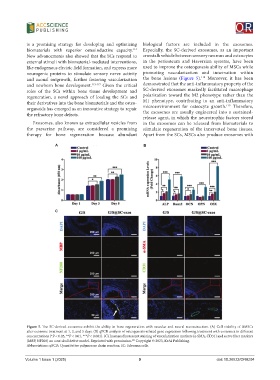
            and axonal outgrowth, further fostering vascularization   the  bone  lesions  (Figure  5).   Moreover,  it  has  been
            and newborn bone development. 115-117  Given the critical   demonstrated that the anti-inflammatory property of the
            roles of the SCs within bone tissue development and   SC-derived exosomes  markedly  facilitated macrophage
            regeneration, a novel approach of loading the SCs and   polarization toward the M2 phenotype rather than the
            their derivatives into the bone biomaterials and the osteo-  M1  phenotype,  contributing  to  an  anti-inflammatory
                                                                                                 119
            organoids has emerged as an innovative strategy to repair   microenvironment for osteocyte growth.  Therefore,
            the refractory bone defects.                      the exosomes are usually engineered into a sustained-
                                                              release agent, in which the neurotrophic factors stored
               Exosomes, also known as extracellular vesicles from   in the exosomes can be released from biomaterials to
            the paracrine pathway, are considered a promising   stimulate regeneration of the innervated bone tissues.
            therapy  for  bone  regeneration  because  abundant   Apart from the SCs, MSCs also produce exosomes with

                         A                                    B


                        C


            Figure 5. The SC-derived exosomes exhibit the ability in bone regeneration with vascular and neural reconstruction. (A) Cell viability of BMSCs
            after exosome treatment at 1, 3, and 5 days. (B) qPCR analysis of osteogenesis-related gene expression following treatment with exosomes in different
            concentrations (*P < 0.05, **P < 0.01, ***P < 0.001). (C) Immunofluorescent staining of vascularization markers (a-SMA, CD31) and nerve fiber markers
            (MBP, NF200) on a rat skull defect model. Reprinted with permission.  Copyright © 2023, KeAi Publishing.
                                                         121
            Abbreviations: qPCR: Quantitative polymerase chain reaction; SC: Schwann cells.

            Volume 1 Issue 1 (2025)                         9                                doi: 10.36922/OR8294

