


Page 51 - OR-1-1
P. 51
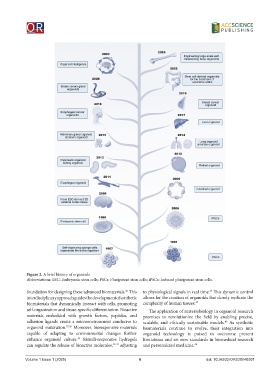
Figure 2. A brief history of organoids
            Abbreviations: ESC: Embryonic stem cells; PSCs: Pluripotent stem cells; iPSCs: Induced pluripotent stem cells.

                                                      36
            foundation for designing these advanced biomaterials.  This   to physiological signals in real time.  This dynamic control
                                                                                          43
            interdisciplinary approach guides the development of synthetic   allows for the creation of organoids that closely replicate the
            biomaterials that dynamically interact with cells, promoting   complexity of human tissues. 44
            self-organization and tissue-specific differentiation. Bioactive   The application of materiobiology in organoid research
            materials embedded with growth factors, peptides, and   promises  to  revolutionize  the  field  by  enabling  precise,
            adhesion ligands create a microenvironment conducive to   scalable, and ethically sustainable models.  As synthetic
                                                                                                 45
            organoid maturation. 37,38  Moreover, bioresponsive materials   biomaterials continue to evolve, their integration into
            capable of adapting to environmental changes further   organoid technology is poised to overcome present
            enhance  organoid  culture.   Stimuli-responsive  hydrogels   limitations and set new standards in biomedical research
                                  39
            can regulate the release of bioactive molecules, 40-42  adjusting   and personalized medicine. 46


            Volume 1 Issue 1 (2025)                         4                            doi: 10.36922/OR025040007

