


Page 126 - OR-1-3
P. 126
Assisted Tissue Emergence” has been proposed, utilizing   With ongoing advancements in stem cell technology,
            3D bioprinting to control geometric shapes and cell   biomaterials, and bioengineering, tendon  organoids
            density, thereby facilitating the generation of centimeter-  are  expected  to  achieve  significant  breakthroughs
            scale tissues with self-organizing characteristics.  The   in structural complexity, functional integrity, and
                                                      74
            continuous evolution of tissue engineering techniques   compatibility with human physiology. The development
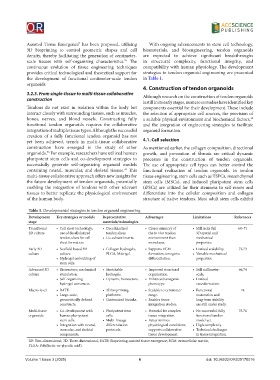
            provides critical technological and theoretical support for   strategies in tendon organoid engineering are presented
            the development of functional centimeter-scale tendon   in Table 1.
            organoids.
                                                              4. Construction of tendon organoids
            3.2.3. From single-tissue to multi-tissue collaborative   Although research on the construction of tendon organoids
            construction
                                                              is still in its early stages, numerous studies have identified key
            Tendons do not exist in isolation within the body but   components essential for their development. These include
            interact closely with surrounding tissues, such as muscles,   the selection of appropriate cell sources, the provision of
            bones, nerves, and blood vessels. Constructing fully   a suitable physical environment and biochemical factors,
                                                                                                            20
            functional  tendon  organoids  requires  the  collaborative   and  the  integration  of  engineering  strategies  to  facilitate
            integration of multiple tissue types. Although the successful   organoid formation.
            creation of a fully functional tendon organoid has not
            yet been achieved, trends in multi-tissue collaborative   4.1. Cell selection
            construction have emerged in the study of other   As mentioned earlier, the collagen composition, directional
                     75
            organoids.  For example, researchers have utilized human   growth, and prevention of fibrosis are critical dynamic
            pluripotent stem cells and co-development strategies to   processes in the construction of tendon organoids.
            successfully generate self-organizing organoid models   The use of appropriate cell types can better control the
            containing neural, muscular, and skeletal tissues.  This   functional realization of tendon organoids. In tendon
                                                      76
            multi-tissue collaborative approach offers new insights for   tissue engineering, stem cells such as TSPCs, mesenchymal
            the future development of tendon organoids, potentially   stem cells (MSCs), and induced pluripotent stem cells
            enabling the integration of tendons with other relevant   (iPSCs) are utilized for their stemness to self-renew and
            tissues to better replicate the physiological environment   differentiate into the cellular composition and collagen
            of the human body.                                structure of native tendons. Most adult stem cells exhibit

             Table 1. Developmental strategies in tendon organoid engineering
             Development   Key strategies or models  Representative   Advantages   Limitations       References
             stage                           materials/technologies
             Transitional   •   Cell sheet technology;   •   Decellularized   •   Closer mimicry of   •   Still lacks full   68–71
             2D culture   use of decellularized   tendon slices.  the in vivo tendon   3D spatial and
                          tendon slices for cell   •   Co-culture inserts.  environment than   mechanical
                          sheet formation.                      monolayer.          properties.
             Early 3D    •   Scaffold-based 3D   •   Collagen hydrogels,   •   Supports ECM   •   Limited scalability.  72,73
             culture      culture.            PLGA, Matrigel.   formation, tenogenic   •   Variable mechanical
                         •   Hydrogel embedding of              differentiation.    properties.
                          stem cells.
             Advanced 3D   •   Bioreactors; mechanical   •   Stretchable   •   Improved structural   •   Still millimeter-  66,74
             culture      stimulation.        hydrogels.        organization.       scale.
                         •   Self-organizing   •   Dynamic bioreactors.  •   Enhanced tenogenic   •   Limited
                          hydrogel constructs.                  phenotype.          vascularization.
             Macro-level  •   BATE.          •   3D bioprinting   •   Scalable to centimeter   •   Functional   74
                         •   Large-scale,     platforms.        range.              maturation and
                          geometrically defined   •   Customized bioinks.  •   Enables tissue   long-term stability
                          constructs.                           integration studies.  are still under study.
             Multi-tissue   •   Co-development with   •   Pluripotent stem   •   Potential for complex   •   No successful, fully   75,76
             organoids    human pluripotent   cells.            tissue integration.  functional tendon
                          stem cells.        •   Multi-lineage   •   Better mimics   model yet.
                         •   Integration with neural,   differentiation   physiological conditions;   •   High complexity.
                          muscular, and skeletal   protocols.   supports collaborative   •   Technical challenges
                          components.                           tissue development.  in tissue integration.
             2D: Two-dimensional; 3D: Three-dimensional; BATE: Bioprinting-assisted tissue emergence; ECM: extracellular matrix;
             PLGA: Poly(lactic-co-glycolic acid).


            Volume 1 Issue 3 (2025)                         6                            doi: 10.36922/OR025170016

