


Page 134 - OR-1-3
P. 134
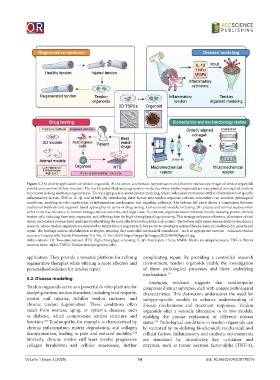
Figure 3. The diverse applications of tendon organoids. At the center, a schematic representation and electron microscopy images of tendon organoids
            provide an overview of their structure. The top left panel illustrates regenerative medicine, where tendon organoids are transplanted into injured tendons
            to promote healing and tissue regeneration. The top right panel is about disease modeling, where inflammatory tendons exhibit elevated levels of specific
            inflammatory factors, TNF-α, IL-1β, and MMPs. By introducing these factors into tendon organoid cultures, researchers can simulate pathological
            conditions, enabling in vitro exploration of inflammation mechanisms and signaling pathways. The bottom left panel shows a comparison between
            traditional methods and organoid-based approaches in terms of drug testing. Conventional models, including 2D cultures and animal studies, often
            suffer from low relevance to human biology, ethical concerns, and high costs. In contrast, organoid-based methods involve isolating patient-derived
            tendon cells, inducing them into organoids, and utilizing them for high-throughput drug screening. This strategy enhances relevance, eliminates ethical
            issues, and enables personalized medicine by identifying the most effective treatment for each patient. The bottom right panel demonstrates biomechanics
            research, where tendon organoids are subjected to tensile force using a stretch bioreactor to investigate optimal biomechanical conditions for growth and
            repair. The findings inform rehabilitation strategies, ensuring that controlled mechanical stimulation—such as appropriate exercise—enhances tendon
            recovery. Created with Adobe Photoshop Yixi Wu, Zi Yin (2025) https://imgur.la/images/2025/09/09/figure3.jpg.
            Abbreviations: 2D: Two-dimensional; HTS: High-throughput screening; IL-1β: Interleukin-1 beta; MMPs: Matrix metalloproteinases; TNF-α: Tumor
            necrosis factor-alpha; TSPCs: Tendon stem/progenitor cells.


            application. They provide a versatile platform for refining   complicating repair. By providing a controlled research
            regenerative therapies while offering a more effective and   environment,  tendon  organoids  enable  the  investigation
            personalized solution for tendon repair.          of these pathological processes and their underlying
                                                              mechanisms. 175
            5.2. Disease modeling
                                                                Emerging evidence suggests that tendinopathy
            Tendon organoids serve as a powerful in vitro platform for   comprises distinct subtypes, each with unique pathological
            studying various tendon disorders, including tendinopathy,   characteristics. This distinction underscores the need for
            rotator cuff injuries, Achilles tendon ruptures, and   subtype-specific models to enhance understanding of
            chronic tendon degeneration. These conditions often   disease mechanisms and treatment responses. Tendon
            result from overuse, aging, or systemic  diseases, such   organoids offer a versatile alternative to  in vivo models,
            as diabetes, which compromise tendon structure and   enabling the precise replication of different disease
            function.  Tendinopathy, for example, is characterized by   states.  Pathological conditions in tendon organoids can
                    167
                                                                   176
            chronic  inflammation,  matrix  degradation,  and  collagen   be recreated by modulating biochemical, mechanical, and
            disorganization, leading to pain and reduced mobility.    cellular factors. Inflammatory and catabolic environments
                                                          174
            Similarly, chronic rotator cuff tears involve progressive   are  simulated by  introducing key cytokines  and
            collagen breakdown and cellular senescence, further   enzymes, such as tumor necrosis factor-alpha (TNF-α),

            Volume 1 Issue 3 (2025)                         14                           doi: 10.36922/OR025170016

