


Page 132 - OR-1-3
P. 132
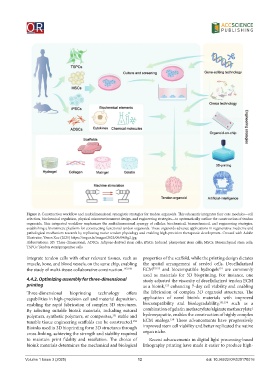
Figure 2. Construction workflow and multidimensional synergistic strategies for tendon organoids. This schematic integrates four core modules—cell
            selection, biochemical regulation, physical microenvironment design, and engineering strategies—to systematically outline the construction of tendon
            organoids. This integrated workflow emphasizes the multidimensional synergy of cellular, biochemical, biomechanical, and engineering strategies,
            establishing a biomimetic platform for constructing functional tendon organoids. These organoids advance applications in regenerative medicine and
            pathological mechanism research by replicating native tendon physiology and enabling high-precision therapeutic development. Created with Adobe
            Illustrator, Yiwen Xue (2025) https://imgur.la/images/2025/09/09/fig2.jpg.
            Abbreviations: 3D: Three-dimensional; ADSCs: Adipose-derived stem cells; iPSCs: Induced pluripotent stem cells; MSCs: Mesenchymal stem cells;
            TSPCs: Tendon stem/progenitor cells.

            integrate tendon cells with other relevant tissues, such as   properties of the scaffold, while the printing design dictates
            muscle, bone, and blood vessels, on the same chip, enabling   the spatial arrangement of seeded cells. Decellularized
            the study of multi-tissue collaborative construction. 147,150  ECM 87,153  and biocompatible hydrogels  are commonly
                                                                                              151
                                                              used as materials for 3D bioprinting. For instance, one
            4.4.2. Optimizing assembly for three-dimensional   study adjusted the viscosity of decellularized tendon ECM
            printing                                          as a bioink,  enhancing 7-day cell viability and enabling
                                                                       153
            Three-dimensional  bioprinting  technology  offers  the fabrication of complex 3D organoid structures. The
            capabilities in high-precision cell and material deposition,   application of novel bioink materials with improved
            enabling the rapid fabrication of complex 3D structures.   biocompatibility and biodegradability, 151,154  such as a
            By selecting suitable bioink materials, including natural   combination of gelatin methacrylate/alginate methacrylate/
            polymers, synthetic polymers, or composites,  stable and   hydroxyapatite, enables the construction of highly complex
                                                 151
                                                                         154
            tunable tissue engineering scaffolds can be constructed.    ECM analogs.  These advancements have progressively
                                                          152
            Bioinks used in 3D bioprinting form 3D structures through   improved stem cell viability and better replicated the native
            cross-linking, achieving the strength and stability required   organ niche.
            to maintain print fidelity and resolution. The choice of   Recent advancements in digital light processing-based
            bioink materials determines the mechanical and biological   lithography printing have made it easier to produce high-


            Volume 1 Issue 3 (2025)                         12                           doi: 10.36922/OR025170016

