


Page 116 - TD-3-3
P. 116
Tumor Discovery                                                               E-cadherin and p53 in AEL


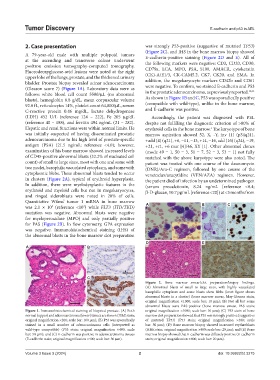
            2. Case presentation                               was strongly P53-positive (suggestive of mutated  TP53)
                                                               (Figure 2C), and IHS in the bone marrow biopsy showed
            A 79-year-old male with multiple polypoid tumors   E-cadherin-positive staining (Figure  2D  and  E). All of
            at the ascending and transverse colons underwent   the following markers were negative: CD3, CD20, CD30,
            positron emission tomography-computed tomography.   CD79a,  LCA,  MPO,  PSA,  S100, AMACR,  cytokeratin
            Fluorodeoxyglucose-avid lesions were noted at the right   (CK)-A/E1/3,  CK-CAM5.2,  CK7,  CK20,  and EMA.  In
            upper lobe of the lungs, prostate, and the thickened urinary   addition, the megakaryocyte markers CD42b and CD61
            bladder. Prostate biopsy revealed acinar adenocarcinoma
            (Gleason  score  7)  (Figure  1A).  Laboratory  data  were  as   were negative. To confirm, we stained E-cadherin and P53
                                                                                                           10,11
            follows: white blood cell count 5500/µL (no abnormal   in the prostatic adenocarcinoma, as previously reported.
            blasts), hemoglobin 8.8  g/dL, mean corpuscular volume   As shown in Figure 1B and C, P53 was sporadically positive
            92.0 fL, reticulocytes 14%, platelet count 64,000/µL, serum   (compatible with wild-type), unlike in the bone marrow,
            C-reactive protein 0.46  mg/dL, lactate dehydrogenase   and E-cadherin was positive.
            (LDH)  452  U/L  (reference  124  –  222),  Fe  205  µg/dL   Accordingly, the patient was diagnosed with PEL
            (reference 40 – 188), and ferritin 494 ng/mL (21 – 282).   despite not fulfilling the diagnostic criterion of >80% of
            Hepatic and renal functions were within normal limits. He   erythroid cells in the bone marrow.  The karyotype of bone
                                                                                           1
            was  initially  suspected of  having disseminated prostatic   marrow  aspiration  showed  52,  X,  -Y,  inv  (1)  (p34q21),
            adenocarcinoma due to his high level of prostate-specific   +add (4) (q21), +6, −11, −13, +14, −16, add (16) (q24), −19,
            antigen (PSA) (21.5  ng/mL: reference <4.0); however,   +21, +r1, +6 mar [4]/46, XY [1]. Other abnormal clones
            examination of his bone marrow showed increased levels   (mode 49 = 1, 50 = 3, 51 = 7, 52 = 3, 53 = 1) not fully
            of CD45-positive abnormal blasts (32.2% of nucleated cell   matched with the above karyotype were also noted. The
            count) of small to large sizes, most with one and some with   patient was treated with one course of the daunomycin
            two nuclei, basophilic vacuolated cytoplasm, and some with   (DNR)/Ara-C  regimen,  followed  by  one  course  of  the
            cytoplasmic blebs. These abnormal blasts tended to occur   venetoclax/azacytidine (VEN/AZA) regimen. However,
            in  clusters  (Figure  2A),  typical  of  erythroid  hyperplasia.   the patient died of infection by an undetermined pathogen
            In addition, there were myelodysplastic features in the   (serum procalcitonin, 8.24  ng/mL [reference <0.4;
            erythroid and myeloid cells but not in megakaryocytes,   β-D-glucan, 10.7 pg/mL [reference <20]) at <3 months from
            and ringed sideroblasts were noted in 20% of cells.
            Quantitative Wilms’ tumor 1 mRNA in bone marrow    A                       B          C
            was  2.1  ×  10   (reference  <10 )  while  FLT3  (ITD/TKD)
                       4
                                    2
            mutation was negative. Abnormal blasts were negative
            for  myeloperoxidase  (MPO)  and  only partially  positive
            for PAS (Figure 2B). In flow cytometry, GPA expression
            was negative. Immunohistochemical staining (IHS) of
            the abnormal blasts in the bone marrow clot preparation
                                                               D                       E
            A                         B


                                      C
                                                               Figure  2. Bone marrow  smear/clot  preparation/biopsy findings.
                                                               (A)  Abnormal blasts of small to large sizes, with highly vacuolated
                                                               basophilic  cytoplasm  and  some  blasts  show  blebs  (inset  figure  shows
                                                               abnormal blasts in a cluster) (bone marrow smear, May-Giemsa stain;
                                                               original magnification ×1000; scale bar: 10 µm); (B) Not all but some
                                                               abnormal blasts were PAS-positive (bone marrow smear, PAS stain;
            Figure 1. Immunohistochemical staining of biopsied prostate. (A) Both   original magnification ×1000; scale bar: 10 µm); (C) P53 stain of bone
            normal (upper) and adenocarcinoma (lower) tissues are shown (H&E stain;   marrow clot preparation showed that P53 was strongly positive (suggestive
            original magnification ×200; scale bar: 100 µm); (B) P53 was sporadically   of mutated  TP53) (P53 stain; original magnification ×400; scale
            stained in a small number of adenocarcinoma cells (interpreted as   bar: 50 µm); (D) Bone marrow biopsy showed increased erythroblasts
            wild-type compatible) (P53 stain; original magnification ×400; scale   (H&E stain; original magnification ×400; scale bar: 20 µm); and (E) Bone
            bar: 50 µm); and (C) E-cadherin was positive in adenocarcinoma tissues   marrow biopsy showed that E-cadherin was diffusely positive (E-cadherin
            (E-cadherin stain; original magnification ×400; scale bar: 50 µm).  stain; original magnification ×400; scale bar: 20 µm).


            Volume 3 Issue 3 (2024)                         2                                 doi: 10.36922/td.3275

