


Page 112 - TD-3-3
P. 112
Tumor Discovery                                                                       Columella fistula


            seizures. He was referred to us from the pediatric   3. Discussion
            department, where he was being followed due to the
            observation  by  his  pediatrician  of  a  fistula  at  the  level   Cysts  and  fistulas  of  the  dorsum  of  the  nose  are  rare
                                                               malformations, strictly confined to the midline, extending
            of the columella, with pus discharge in the context of   from the columella to the glabella.  Occasionally,
                                                                                                2-4
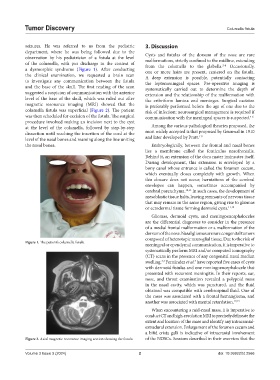
            a dysmorphic syndrome (Figure  1). After conducting   one or more hairs are present, centered on the fistula.
            the clinical examination, we requested a brain scan   A  deep extension is  possible,  potentially contacting
            to investigate any communication between the fistula   the leptomeningeal spaces. Pre-operative imaging is
            and the base of the skull. The first reading of the scan   systematically carried out to determine the depth of
            suggested a suspicion of communication with the anterior   extension and the relationship of the malformation with
            level of the base of the skull, which was ruled out after   the cribriform lamina and meninges. Surgical excision
            magnetic resonance imaging (MRI) showed that the   is preferably performed before the age of one due to the
            columella fistula was superficial (Figure  2). The patient   risk of infection; neurosurgical management is required if
            was then scheduled for excision of the fistula. The surgical   communication with the meningeal spaces is suspected. 4-6
            procedure involved making an incision next to the cyst
            at the level of the columella, followed by step-by-step   Among the various pathological theories proposed, the
            dissection until reaching the insertion of the cord at the   most widely accepted is that proposed by Grunwal in 1910
                                                                                      7-9
            level of the nasal bones and reaming along the line uniting   and later developed by Pratt.
            the nasal bones.                                     Embryologically, between the frontal and nasal bones
                                                               lies a membrane called the fonticulus nasofrontalis.
                                                               Behind it, an extension of the dura mater insinuates itself.
                                                               During development, this extension is enveloped by a
                                                               bony canal whose entrance is called the foramen cecum,
                                                               which eventually closes completely with growth. When
                                                               this closure does not occur, herniations of the cerebral
                                                               envelopes can happen, sometimes accompanied by
                                                               cerebral parenchyma. 10,11  In such cases, the development of
                                                               mesoblastic tissue halts, leaving remnants of nervous tissue
                                                               that may remain in the same region, giving rise to gliomas
                                                               or ectodermal tissue forming dermoid cysts. 11,12

                                                                 Gliomas, dermoid cysts, and meningoencephaloceles
                                                               are the differential diagnoses to consider in the presence
                                                               of a medial frontal malformation or a malformation of the
                                                               dorsum of the nose. Nasal gliomas are rare congenital tumors
                                                               composed of heterotopic neuroglial tissue. Due to the risk of
            Figure 1. The patient’s columella fistula
                                                               meningeal or ependymal communication, it is imperative to
                                                               systematically perform MRI and/or computed tomography
                                                               (CT) scans in the presence of any congenital nasal median
                                                               swelling.  Fernàndez et al.  have reported five cases of cysts
                                                                      3,4
                                                                                    3
                                                               with dermoid fistulas and one meningoencephalocele that
                                                               presented with recurrent meningitis. In their reports, ear,
                                                               nose, and throat examination revealed a polypoid mass
                                                               in the nasal cavity, which was punctured, and the fluid
                                                               obtained was compatible with cerebrospinal fluid. One of
                                                               the cases was associated with a frontal hemangioma, and
                                                               another was associated with mental retardation. 12,13

                                                                 When encountering a mid-nasal mass, it is imperative to
                                                               conduct CT and high-resolution MRI to precisely delineate the
                                                               extent and location of the mass and identify any intracranial-
                                                               extradural extension. Enlargement of the foramen cecum and
                                                               a bifid crista galli is indicative of intracranial involvement
            Figure 2. Axial magnetic resonance imaging section showing the fistula  of the NDSCs. Sessions described in their overview that the


            Volume 3 Issue 3 (2024)                         2                                 doi: 10.36922/td.2566

