


Page 107 - TD-3-3
P. 107
Tumor Discovery                                                   Effectiveness of AI imaging for lung nodules


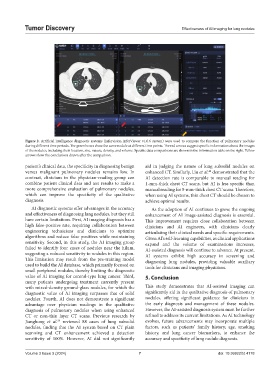
            Figure 2. Artificial intelligence diagnostic systems (Infervision InferViewer v1.0.6 system) were used to compare the function of pulmonary nodules
            during different time periods. The green boxes show the same nodule at different time points. The red arrows suggest specific information about the images
            of the nodules, including their location, size, nature, density, and volume. Specific data comparisons are shown in the information table on the right. Yellow
            arrows show the conclusions drawn after the comparison.

            patient’s clinical data, the specificity in diagnosing benign   aid in judging the nature of lung subsolid nodules on
            versus malignant pulmonary nodules remains low. In   enhanced CT. Similarly, Liu et al.  demonstrated that the
                                                                                          40
            contrast, clinicians in the physician-reading group can   AI detection rate is comparable to manual reading for
            combine patient clinical data and test results to make a   1-mm-thick chest CT scans, but AI is less specific than
            more comprehensive evaluation of pulmonary nodules,   manual reading for 5-mm-thick chest CT scans. Therefore,
            which can improve the specificity of the qualitative   when using AI systems, thin chest CT should be chosen to
            diagnosis.                                         achieve optimal results.
              AI diagnostic systems offer advantages in the accuracy   As the adoption of AI continues to grow, the ongoing
            and effectiveness of diagnosing lung nodules, but they still   enhancement of AI image-assisted diagnosis is essential.
            have certain limitations. First, AI imaging diagnosis has a   This improvement requires close collaboration between
            high false-positive rate, requiring collaboration between   clinicians and AI engineers, with clinicians clearly
            engineering technicians and clinicians to optimize   articulating their clinical needs and specific requirements.
            algorithms and reduce false positives while maintaining   Given AI’s self-learning capabilities, as clinical applications
            sensitivity.  Second,  in this  study, the AI imaging  group   expand and the volume of examinations increases,
            failed to identify four cases of nodules near the hilum,   AI-assisted diagnosis will continue to advance. At present,
            suggesting a reduced sensitivity to nodules in this region.   AI systems exhibit high accuracy in screening and
            This limitation may result from the pre-training model   diagnosing lung nodules, providing valuable auxiliary
            used to build the AI database, which primarily focused on   tools for clinicians and imaging physicians.
            small peripheral nodules, thereby limiting the diagnostic
            value of AI imaging for central-type lung cancer. Third,   5. Conclusion
            many patients undergoing treatment currently present
            with mixed-density ground-glass nodules, for which the   This study demonstrates that AI-assisted imaging can
            diagnostic value of AI imaging surpasses that of solid   significantly aid in the qualitative diagnosis of pulmonary
            nodules. Fourth, AI does not demonstrate a significant   nodules, offering significant guidance for clinicians in
            advantage over physician readings in the qualitative   the early diagnosis and management of these nodules.
            diagnosis of pulmonary nodules when using enhanced   However, the AI-assisted diagnosis system must be further
            CT  or  non-thin layer  CT  scans.  Previous  research  by   refined to address its current limitations. As AI technology
            Jianghong  et al.  reviewed 88  cases of lung subsolid   evolves, future advancements may incorporate multiple
                         39
            nodules, finding that the AI system based on CT plain   factors, such as patients’ family history, age, smoking
            scanning and CT enhancement achieved a detection   history, and lung cancer biomarkers, to enhance the
            sensitivity  of  100%.  However,  AI  did  not  significantly   accuracy and specificity of lung nodule diagnosis.


            Volume 3 Issue 3 (2024)                         7                                 doi: 10.36922/td.4178

