


Page 105 - TD-3-3
P. 105
Tumor Discovery                                                   Effectiveness of AI imaging for lung nodules


            group, the AUC was 0.737, with a sensitivity of 83.19%   showed higher specificity than the AI group (Figure  1
            (95% CI: 0.7766 – 0.8782) and a specificity of 66.15%   and Table 5).
            (95% CI: 0.5335 – 0.7743). Both the AI group and the
            physician-reading group demonstrated good predictive   4. Discussion
            value for the qualitative diagnosis of lung nodules. The   Primary bronchopulmonary cancer, commonly known
            AI group exhibited higher sensitivity compared to the   as lung cancer, is a globally significant malignant tumor
            physician-reading group, while the physician group   with high mortality rates.  In 2022, lung cancer was
                                                                                     28
                                                               the most common malignancy in China, accounting
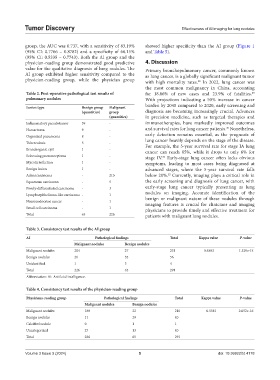
            Table 2. Post‑operative pathological test results of   for 18.06% of new cases and 23.9% of fatalities.
                                                                                                            29
            pulmonary nodules                                  With projections indicating a 50% increase in cancer
                                                               burden by 2040 compared to 2020, early screening and
            Lesion type             Benign group   Malignant
                                    (quantities)  group        diagnosis are becoming increasingly crucial. Advances
                                               (quantities)    in precision medicine, such as targeted therapies and
            Inflammatory pseudotumor  39       -               immunotherapies, have markedly improved outcomes
                                                                                                 30
            Hamartoma               9          -               and survival rates for lung cancer patients.  Nonetheless,
            Organized pneumonia     8          -               early detection remains essential, as the prognosis of
                                                               lung cancer heavily depends on the stage of the disease.
            Tuberculosis            5          -               For example, the 5-year survival rate for stage IA lung
            Bronchogenic cyst       1          -               cancer can reach 85%, while it drops to only 6% for
            Sclerosing pneumocytoma  1         -               stage IV.  Early-stage lung cancer often lacks obvious
                                                                      31
            Mycotic infection       1          -               symptoms, leading to most cases being diagnosed at
            Benign lesion           1          -               advanced stages, where the 5-year survival rate falls
            Adenocarcinoma          -          215             below 20%.  Currently, imaging plays a critical role in
                                                                        32
            Squamous carcinoma      -          5               the early screening and diagnosis of lung cancer, with
            Poorly-differentiated carcinoma  -  3              early-stage lung cancer typically presenting as lung
            Lymphoepithelioma-like carcinoma -  1              nodules on imaging. Accurate identification of the
                                                               benign  or  malignant  nature  of  these  nodules  through
            Neuroendocrine cancer   -          1               imaging features is crucial for clinicians and imaging
            Small cell carcinoma    -          1               physicians to provide timely and effective treatment for
            Total                   65         226             patients with malignant lung nodules.


            Table 3. Consistency test results of the AI group
            AI                           Pathological findings           Total        Kappa value      P‑value
                                 Malignant nodules    Benign nodules
            Malignant nodules    204                  27                 231            0.4883         1.529e-14
            Benign nodules       21                   35                 56
            Unidentified         1                    3                  4
            Total                226                  65                 291
            Abbreviation: AI: Artificial intelligence.

            Table 4. Consistency test results of the physician‑reading group
            Physicians‑reading group         Pathological findings         Total       Kappa value     P‑value
                                     Malignant nodules   Benign nodules
            Malignant nodules        188                 22                210           0.5581        2.052e-16
            Benign nodules           11                  29                40
            Calcified nodule         0                   1                 1
            Uncategorized            27                  13                40
            Total                    226                 65                291


            Volume 3 Issue 3 (2024)                         5                                 doi: 10.36922/td.4178

