


Page 104 - TD-3-3
P. 104
Tumor Discovery                                                   Effectiveness of AI imaging for lung nodules


            qualitative diagnosis of lung nodules and the pathological   carcinoma, neuroendocrine carcinoma, and small cell
            results, which served as the gold standard. To assess the   carcinoma. Inflammatory pseudotumors predominantly
            diagnostic performance of both the AI and physician   characterized benign nodules, while lung adenocarcinoma
            readings in identifying benign and malignant lung   was the most common malignant nodule. We present the
            nodules, we employed the receiver operating characteristic   detailed statistics of pathological diagnoses in Table 2.
            (ROC) curve. Sensitivity and specificity were calculated   We compared AI-assisted diagnostic results with
            based on the optimal cutoff value determined from the   the pathological examination results. Among the 226
            ROC analysis.
                                                               malignant lung nodules confirmed by pathology, AI
            3. Results                                         correctly diagnosed 204 as malignant, misclassified 21 as
                                                               benign, and failed to recognize one nodule (located near
            3.1. Basic clinical information                    the hilum). Among the 65 benign lung nodules confirmed
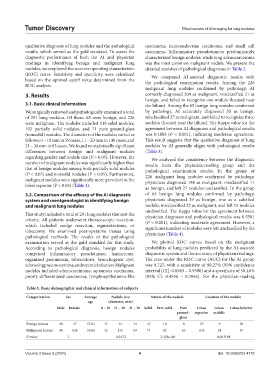
            We surgically removed and pathologically examined a total   by pathology, AI accurately diagnosed 35 as benign,
            of 291 lung nodules. Of these, 65 were benign, and 226   misclassified 27 as malignant, and failed to recognize three
            were malignant. The nodules included 118 solid nodules,   nodules (located near the hilum). The Kappa value for the
            102 partially solid nodules, and 71 pure ground-glass   agreement between AI diagnoses and pathological results
            (nonsolid) nodules. The diameters of the nodules varied as   was 0.4883 (P < 0.001), indicating moderate agreement.
            follows: 0 – 10 mm in 59 cases, 11 – 20 mm in 149 cases, and   This result suggests that the qualitative diagnosis of lung
            21 – 30 mm in 83 cases. We found no statistically significant   nodules by AI generally aligns with pathological results
            differences between benign and malignant nodules   (Table 3).
            regarding gender and nodule size (P > 0.05). However, the   We analyzed the consistency between the diagnostic
            number of malignant nodules was significantly higher than   results from the physician-reading group and the
            that of benign nodules among both partially solid nodules   pathological examination results. In the group of
            (P < 0.05) and nonsolid nodules (P < 0.05). Furthermore,   226 malignant lung nodules confirmed by pathology,
            malignant nodules were significantly more prevalent in the   physicians diagnosed 188 as malignant, misclassified 11
            lobes superior (P < 0.05) (Table 1).
                                                               as benign, and left 27 nodules unclassified. In the group
            3.2. Comparison of the efficacy of the AI diagnostic   of 65 benign lung nodules confirmed by pathology,
            system and roentgenologist in identifying benign   physicians diagnosed 29 as benign, one as a calcified
            and malignant lung nodules                         nodule, misclassified 22 as malignant, and left 13 nodules
                                                               unclassified. The Kappa value for the agreement between
            This study included a total of 291 lung nodules that met the   physician diagnoses and pathological results was 0.5581
            criteria. All patients underwent thoracoscopic resection,   (P < 0.001), indicating moderate agreement. However, a
            which included wedge resection, segmentectomy, or   significant number of nodules were left unclassified by the
            lobectomy.  We  examined  post-operative  tissues  using   physicians (Table 4).
            pathological methods. The results of the pathological
            examination served as the gold standard for this study.   We plotted ROC curves based on the malignant
            According to pathological diagnosis, benign nodules   probability of lung nodules predicted by the AI-assisted
            comprised inflammatory pseudotumor, hamartoma,     diagnostic system and the accuracy of physician readings.
            organized pneumonia, tuberculosis, bronchogenic cyst,   The area under the ROC curve (AUC) for the AI group
            sclerosing pneumocytoma, and mycotic infection. Malignant   was 0.727, with a sensitivity of 90.27% (95% confidence
            nodules included adenocarcinoma, squamous carcinoma,   interval [CI]: 0.8563 – 0.9380) and a specificity of 58.46%
            poorly differentiated carcinoma, lymphoepithelioma-like   (95% CI: 0.4556 – 0.7056). For the physician-reading

            Table 1. Basic demographic and clinical information of subjects
            Categorization   Sex     Average    Nodule size      Nature of the nodule   Location of the nodule
                                      age      (diameter, mm)
                         Male  Female       0 – 10  11 – 20  21 – 30  Solid  Part‑solid  Pure   Lobus   Lobus   Lobus inferior
                                                                            ground‑   superior  middle
                                                                             glass
            Benign lesions  28  37    57.61  17    34     14    47    10       8      27      9        29
            Malignant lesions  98  128  59.86  42  115    69    71    92      63      145     24       57
            P-value           1                   0.2372             2.428e-08               0.003591


            Volume 3 Issue 3 (2024)                         4                                 doi: 10.36922/td.4178

