


Page 106 - TD-3-3
P. 106
Tumor Discovery                                                   Effectiveness of AI imaging for lung nodules


              Analyzing a large volume of CT images presents a   cancer screening and diagnosis.  Our project’s results
                                                                                          26
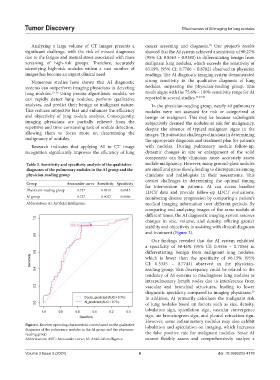
            significant challenge, with the risk of missed diagnoses   showed that the AI system achieved a sensitivity of 90.27%
            due to the fatigue and mental stress associated with mass   (95% CI: 0.8563 – 0.9380) in differentiating benign from
            screening of high-risk groups. Therefore, accurately   malignant lung nodules, which exceeds the sensitivity of
            identifying high-risk nodules within a vast number of   83.19% (95% CI: 0.7766 – 0.8782) observed in physician
            images has become an urgent clinical need.         readings. The AI diagnostic imaging system demonstrated
              Numerous studies have shown that AI diagnostic   strong sensitivity in the qualitative diagnosis of lung
            systems can outperform imaging physicians in detecting   nodules, surpassing the physician-reading group. This
            lung nodules. 33-36  Using precise algorithmic models, we   result aligns with the 75.6% – 100% sensitivity range for AI
            can rapidly  detect lung  nodules, perform qualitative   reported in several studies. 33,37,38
            analyses, and predict their benign or malignant nature.   In the physician-reading group, nearly 40 pulmonary
            This reduces subjective bias and enhances the efficiency   nodules were not assessed for risk or categorized as
            and objectivity of lung nodule  analysis.  Consequently,   benign or malignant. This may be because radiologists
            imaging physicians are partially relieved from the   subjectively deemed the nodules at risk for malignancy,
            repetitive and time-consuming task of nodule detection,   despite the absence of typical malignant signs in the
            allowing them to focus more on determining the     images. This situation challenges clinicians in determining
            malignancy of nodules.                             the appropriate diagnosis and treatment plan for patients
              Research indicates that applying AI to CT image   with nodules. During pulmonary nodule follow-up,
            recognition significantly improves the efficiency of lung   dynamic changes in size or enlargement of the solid
                                                               component can help clinicians more accurately assess
            Table 5. Sensitivity and specificity analysis of the qualitative   nodule malignancy. However, many ground-glass nodules
            diagnoses of the pulmonary nodules in the AI group and the   are small and grow slowly, leading to discrepancies among
            physician‑reading group                            clinicians and radiologists in their assessments. This
                                                               creates challenges in determining the optimal timing
            Group             Area under curve Sensitivity Specificity  for intervention in patients. AI can access baseline
            Physicians-reading group  0.737  0.8319  0.6615    LDCT data and provide follow-up LDCT evaluations,
            AI group              0.727     0.9027  0.5846     monitoring disease progression by comparing a patient’s
            Abbreviation: AI: Artificial intelligence.         medical imaging information over different periods. By
                                                               comparing and analyzing images of the same nodule at
                                                               different times, the AI diagnostic imaging system assesses
                                                               changes in size, volume, and density, offering greater
                                                               stability and objectivity in assisting with clinical diagnosis
                                                               and treatment (Figure 2).
                                                                 Our findings revealed that the AI system exhibited
                                                               a specificity of 58.46% (95% CI: 0.4556 – 0.7056) in
                                                               differentiating benign from malignant lung nodules,
                                                               which is lower than the specificity of 66.15% (95%
                                                               CI: 0.5335 – 0.7743) observed in the physician-
                                                               reading group. This discrepancy could be related to the
                                                               tendency of AI systems to misdiagnose lung nodules as
                                                               intrapulmonary lymph nodes due to interference from
                                                               vascular and bronchial structures, leading to lower
                                                               diagnostic specificity compared to imaging physicians.
                                                                                                            19
                                                               In addition, AI primarily calculates the malignant risk
                                                               of  lung  nodules  based  on  factors  such  as  size,  density,
                                                               lobulation sign, spiculation sign, vascular convergence
                                                               sign, air bronchogram sign, and pleural retraction sign.
                                                               However, some inflammatory nodules may also exhibit
            Figure 1. Receiver operating characteristic curves based on the qualitative   lobulation and spiculation on imaging, which increases
            diagnoses of the pulmonary nodules in the AI group and the physician-
            reading group                                      the false positive rate for malignant nodules. Since AI
            Abbreviations: AUC: Area under curve; AI: Artificial intelligence.  cannot flexibly assess and comprehensively analyze a


            Volume 3 Issue 3 (2024)                         6                                 doi: 10.36922/td.4178

