


Page 13 - TD-3-3
P. 13
Tumor Discovery                                                    Immune and epigenetic therapies for TNBC


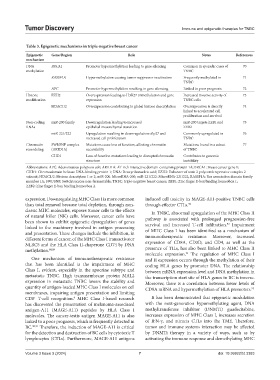
            Table 3. Epigenetic mechanisms in triple‑negative breast cancer
            Epigenetic   Gene/Region                   Role                            Notes         References
            mechanism
            DNA        BRCA1          Promoter hypermethylation leading to gene silencing  Common in sporadic cases of   70
            methylation                                                        TNBC
                       RASSF1A        Hypermethylation causing tumor suppressor inactivation  Frequently methylated in   71
                                                                               TNBC
                       APC            Promoter hypermethylation resulting in gene silencing  Linked to poor prognosis  72
            Histone    EZH2           Overexpression leading to H3K27 trimethylation and gene   Increased invasive activity of   73
            modification              repression                               TNBC cells
                       HDAC1/2        Overexpression contributing to global histone deacetylation  Overexpression is directly   74
                                                                               linked to accelerated cell
                                                                               proliferation and survival
            Non-coding   miR-200 family  Downregulation leading to increased   miR-200 targets ZEB1 and   75
            RNAs                      epithelial-mesenchymal transition        ZEB2
                       miR-221/222    Upregulation resulting in downregulation of p27 and   Commonly upregulated in   76
                                      increased cell proliferation             TNBC
            Chromatin   SWI/SNF complex   Mutations cause loss of function, affecting chromatin   Mutations found in a subset   77
            remodeling  (ARID1A)      accessibility                            of TNBC
                       CHD1           Loss of function mutations leading to disrupted chromatin   Contributes to genomic
                                      structure                                instability
            Abbreviations: APC: Adenomatous polyposis coli; ARID1A: AT-rich interactive domain-containing protein 1A; BRCA1: Breast cancer gene 1;
            CHD1: Chromodomain helicase DNA-binding protein 1; DNA: Deoxyribonucleic acid; EZH2: Enhancer of zeste 2 polycomb repressive complex 2
            subunit; HDAC1/2: Histone deacetylase 1 or 2; miR-200: MicroRNA-200; miR-221/222: MicroRNA-221/222; RASSF1A: Ras association domain family
            member 1A; SWI/SNF: Switch/sucrose non-fermentable; TNBC: triple-negative breast cancer; ZEB1: Zinc finger E-box binding homeobox 1;
            ZEB2: Zinc finger E-box binding homeobox 2.

            expression. Downregulating MHC Class I is more common   induced cell toxicity in MAGE-A11-positive TNBC cells
            than total removal because total depletion, through non-  through effector CTLs. 92
            classic MHC molecules, exposes tumor cells to the effects   In TNBC, abnormal upregulation of the MHC Class II
            of natural killer (NK) cells. Moreover, cancer cells have   pathway is associated with prolonged progression-free
            been shown to exhibit epigenetic dysregulation of genes   survival and increased T-cell infiltration.  Impairment
                                                                                                  93
            linked to the machinery involved in antigen processing   of MHC Class  I has been identified as a mechanism of
            and presentation. These changes include the inhibition, in
            different forms of cancer, of the MHC Class I transactivator   immunotherapeutic  resistance.  Moreover,  increased
            NLRC5 and the HLA Class II-chaperone CD74 by DNA   expression of CD8A, CD3D, and CD4, as well as the
            methylation. 88,89                                 presence of TILs, has also been linked to MHC Class II
                                                               molecule expression.  The regulation of MHC Class  I
                                                                                94
              One mechanism of  immunotherapeutic resistance   and II expression occurs through the methylation of their
            that has been identified is the impairment of MHC   coding HLA genes by promoter DNA. The relationship
            Class  I, evident, especially in the apocrine subtype and   between mRNA expression level and DNA methylation in
            metastatic TNBC. High transmembrane protein MAL2   the transcription start site of HLA genes in BC is inverse.
            expression in metastatic TNBC lowers the stability and   Moreover, there is a correlation between lower levels of
            quantity of antigen-loaded MHC Class I molecules on cell   CD8A mRNA and hypermethylation of HLA promoters. 95
            membranes, impairing antigen presentation and limiting
            CD8  T-cell recognition.  MHC Class  I-based research   It has been demonstrated that epigenetic modulation
                                9
                +
            has discovered the presentation of melanoma-associated   with the next-generation hypomethylating agent, DNA
            antigen-A11 (MAGE-A11) peptides by HLA Class  I    methyltransferase inhibitor (DNMTi) guadecitabine,
            molecules.  The  cancer-testis  antigen MAGE-A11 is  also   increases expression of MHC Class I, increases secretion
            linked to a poor prognosis, which is frequently detected in   of IFN-γ, and attracts CTLs into the TME. Therefore,
            BC. 90,91  Therefore, the induction of MAGE-A11 is critical   tumor and immune systems interaction may be affected
            for the detection and destruction of BC cells by cytotoxic T   by DNMTi therapy in a variety of ways, such as by
            lymphocytes (CTLs). Furthermore, MAGE-A11 antigens   activating the immune response and demethylating MHC


            Volume 3 Issue 3 (2024)                         7                                 doi: 10.36922/td.3383

