


Page 101 - TD-4-3
P. 101
Tumor Discovery                                               Complete response to enfortumab vedotin in mBC


            cell surface, EV is internalized and releases the cytotoxic   iliac  vascular structures  (SUVmax:  6.5)  and in  the  right
            agent monomethyl auristatin E, disrupting microtubule   mesorectal fascia (SUVmax: 4.9). A  soft tissue mass
            formation and leading to tumor cell death by apoptosis.    measuring 18 × 34 × 30 mm extending from the right side
                                                          5
            Phase II EV-201 and Phase III EV-301 clinical trials have   of the mesorectum to the right mesorectal fascia at the
            shown significant benefits on progression-free survival   level of the coccyx showed intense FDG uptake (SUVmax:
            (PFS) and overall survival (OS) among patients with locally   13.6). Furthermore, increased pathological FDG uptake
            advanced or mUC who had previously received platinum-  was noted in the soft tissue adjacent to the posterior aspect
            based chemotherapy and programmed cell death protein   of the symphysis pubis (SUVmax: 5.5). PET/CT images are
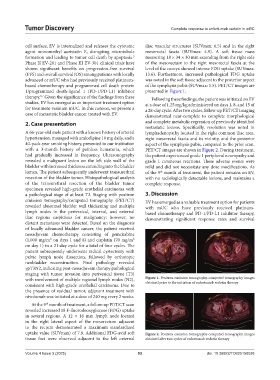
            1/programmed death-ligand 1 (PD-1/PD-L1) inhibitor   presented in Figure 1.
            therapy.  Given the significance of the findings from these   Following these findings, the patient was initiated on EV
                  6,7
            studies, EV has emerged as an important treatment option   at a dose of 1.25 mg/kg administered on days 1, 8, and 15 of
            for treatment-resistant mUC. In this context, we present a   a 28-day cycle. After two cycles, follow-up PET/CT imaging
            case of metastatic bladder cancer treated with EV.  demonstrated near-complete to complete morphological

            2. Case presentation                               and complete metabolic regression of previously identified
                                                               metastatic lesions. Specifically, resolution was noted in
            A 66-year-old male patient with a known history of arterial   lymphadenopathy located in the right common iliac area,
            hypertension, managed with amlodipine 10 mg daily, and a   right mesorectal fascia and its vicinity, and the posterior
            40-pack-year smoking history, presented to our institution   aspect of the symphysis pubis, compared to the prior scan.
            with a 3-month history of painless hematuria, which   PET/CT images are shown in Figure 2. During treatment,
            had gradually increased in frequency. Ultrasonography   the patient experienced grade 1 peripheral neuropathy and
            revealed a malignant lesion on the left side wall of the   grade  1 cutaneous reactions. These adverse events were
            bladder with increased thickness extending into the bladder   mild and did not necessitate any dose modifications. As
            lumen. The patient subsequently underwent transurethral   of the 9  month of treatment, the patient remains on EV,
                                                                     th
            resection of the bladder tumor. Histopathological analysis   with no radiologically detectable lesions, and maintains a
            of the transurethral resection of the bladder tumor   complete response.
            specimen revealed high-grade urothelial carcinoma with
            a pathological stage of at least T2. Staging with positron   3. Discussion
            emission tomography/computed tomography (PET/CT)   EV has emerged as a valuable treatment option for patients
            revealed abnormal bladder wall thickening and multiple   with mUC who have previously received platinum-
            lymph nodes in the perivesical, internal, and external   based chemotherapy and PD-1/PD-L1 inhibitor therapy,
            iliac regions suspicious for malignancy; however, no   demonstrating  significant  response  rates  and  survival
            distant metastases were detected. Based on the diagnosis
            of  locally  advanced  bladder  cancer,  the  patient  received
            neoadjuvant chemotherapy consisting of gemcitabine
            (1,000 mg/m² on days 1 and 8) and cisplatin (70 mg/m²
            on day 1) in a 21-day cycle for a total of four cycles. The
            patient subsequently underwent radical cystectomy with
            pelvic  lymph  node  dissection,  followed  by  orthotopic
            neobladder reconstruction. Final pathology revealed
            ypT3N2, indicating post-neoadjuvant therapy pathological
            staging with tumor invasion into perivesical tissue (T3)
            with involvement of multiple regional lymph nodes (N2),   Figure 1. Positron emission tomography-computed tomography images
            consistent with high-grade urothelial carcinoma. Due to   obtained prior to the initiation of enfortumab vedotin therapy
            the presence of residual tumor, adjuvant treatment with
            nivolumab was initiated at a dose of 240 mg every 2 weeks.
              At the 9  month of treatment, a follow-up PET/CT scan
                     th
            revealed increased 18 F-fluorodeoxyglucose (FDG) uptake
            in  several regions.  A  12  ×  16  mm  lymph  node  located
            in the right lateral aspect of the mesorectum adjacent
            to the rectum demonstrated a maximum standardized
            uptake value (SUVmax) of 7.8. Additional FDG-avid soft   Figure 2. Positron emission tomography-computed tomography images
            tissue foci were observed adjacent to the left external   obtained after two cycles of enfortumab vedotin therapy


            Volume 4 Issue 3 (2025)                         93                           doi: 10.36922/TD025150026

