


Page 51 - AC-2-2
P. 51
Arts & Communication                                      Using multiple languages within an improvised fairytale


                                                                 The tellers were from Canada and China. They decided
                                                               to continue the experiment of using English and Mandarin
                                                               within the story making before the improvisation. All
                                                               improvisers shared a mutual influence among themselves,
                                                               with no clear leader directing the unfolding of the story,
                                                               characters, action, or end. Each of the elements of the fairytale
                                                               evolved from the simultaneous multimodal expression.

                                                               2.5. The fairytale: The boy who learned to laugh in
                                                               all languages
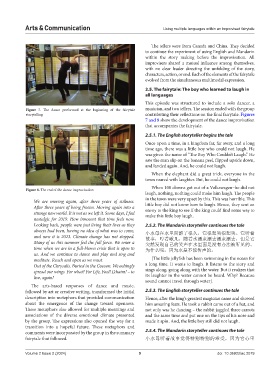
                                                               This episode was structured to include a solo dancer, a
            Figure  7. The dance performed at the beginning of the fairytale   musician, and two tellers. The session ended with the group
            storytelling                                       contributing their reflections on the final fairytale. Figures
                                                               7 and 8 show the development of the dance improvisation
                                                               that accompanies the fairytale.

                                                               2.5.1. The English storyteller begins the tale
                                                               Once upon a time, in a kingdom far, far away, and a long
                                                               time ago, there was a little boy who could not laugh. He
                                                               was given the name of “The Boy Who Couldn’t Laugh.” He
                                                               saw the man slip on the banana peel, flipped upside down,
                                                               and landed again. And, he could not laugh.
                                                                 When the elephant did a great trick, everyone in the
                                                               town roared with laughter. But, he could not laugh.
                                                                 When 100 clowns got out of a Volkswagen–he did not
            Figure 8. The end of the dance improvisation
                                                               laugh, nothing, nothing could make him laugh. The people
               We are moving again, after three years of stillness.   in the town were very upset by this. This was horrible. This
               After three years of being frozen. Moving again into a   little boy did not know how to laugh. Hence, they sent an
                                                               envoy to the king to see if the king could find some way to
               strange new world. It is not as we left it. Some days, I feel   make this little boy laugh.
               nostalgic for 2019. How innocent that time feels now.
               Looking back, people were just living their lives as they   2.5.2. The Mandarin storyteller continues the tale
               always had been, having no idea of what was to come,   小水母在水里面游了很久,它很想笑很想笑。它听着
               and now it is 2023. Climate change has not stopped.   故事,哼着歌儿,随着水漂来漂去漂来漂去,但是它
               Many of us this summer feel the full force. We enter a   突然发现自己的笑声在水里面是没有办法被听见的。
               time when we are in a full-blown crisis that is open to   为什么呢,因为水是不能传声的。
               us. And we continue to dance and play and sing and
               meditate. Reach and open as we must.              [The little jellyfish has been swimming in the ocean for
               Out of the Chrysalis. Buried in the Cocoon. We achingly   a long time. It wants to laugh. It listens to the story and
               spread our wings. For what? For Life, Fool! L’chaim! – to   sings along, going along with the water. But it realizes that
               live, again!                                    its laughter in the water cannot be heard. Why? Because
                                                               sound cannot travel through water].
              The arts-based responses of dance and music,
            followed by art or creative writing, transformed the initial   2.5.3. The English storyteller continues the tale
            description into metaphors that provided communication   Hence, after the king’s greatest magician came and showed
            about the emergence of the change toward openness.   him amazing feats. He took a rabbit came out of a hat, and
            These metaphors also allowed for multiple meanings and   not only was he dancing – the rabbit juggled three carrots
            associations of the diverse emotional climate presented   and the same time and put one on the tips of his nose and
            by the group. The expressions also opened the way for a   made it spin. And, the little boy still did not laugh.
            transition into a hopeful future. These metaphors and
            comments were incorporated by the group in the summary   2.5.4. The Mandarin storyteller continues the tale
            fairytale that followed.                           小水母听着故事觉得特别特别的难受,因为它心里


            Volume 2 Issue 2 (2024)                         9                                doi: 10.36922/ac.2079

