


Page 11 - AIH-1-1
P. 11
Artificial Intelligence in Health                                           AI in prostate cancer detection


            “cancer”), (“machine” AND (“learn” OR “learning”)) OR   The top 20 most cited papers are listed in  Table 1,
            (“artificial”  AND  (“intelligence”  OR  “intelligent”)).  The   showcasing a diverse range of AI and ML approaches
            search results were gathered and filtered to eliminate   addressing different aspects of prostate cancer prediction,
            duplications, and further refinement included limiting the   grading, and image processing using MRI.  Table 2
            results to publications in the English language. However,   summarizes the titles of these highly cited papers. Notably,
            there was no strict imposition on the year of publication.   13 out of 20 papers were published from 2017 onwards, yet
            To ensure the quality of the selected studies, 293 peer-  received a significant number of citations. These citations
            reviewed papers were chosen for further analysis. This   span diverse areas, encompassing histopathological
            curated collection of peer-reviewed articles was exported   diagnoses, including grading, and the use of MRI in both
            as bibliometric data in commonly used formats, such as   diagnosis and the prediction of the diagnosis.
            RIS, BIBTEX, and CSV.
                                                                 Table 2 presents the top 20 most productive and cited
            2.2. Research framework                            authors, the most productive and cited countries, and
                                                               the most affiliated institutions in the field. Notably, the
            In this work, BA was conducted to perform descriptive
            and network analyses using the Bibliometrix R-package .   highest number of publications originated from North
                                                        [28]
            Network  analyses  were further  conducted  using  the   America, followed by Europe. Collectively, the United
            VOSviewer  software .  Figure  1 provides a  visual   States of America (USA), Canada, and China accounted
                             [29]
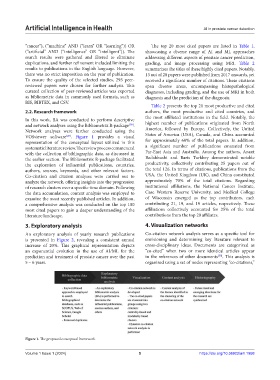
            representation of the conceptual layout utilized in this   for approximately 60% of the total papers. In addition,
            systematic literature review. The review process commenced   a significant number of publications emanated from
            with the collection of bibliographic data, as discussed in   Far-East Asia and Australia. Among the authors, Anant
            the earlier section. The Bibliometrix R-package facilitated   Badabhushi and Baris Turkbey demonstrated notable
            the exploration of influential publications, countries,   productivity, collectively  contributing  25 papers out  of
            authors, sources, keywords, and other relevant factors.   the total 126. In terms of citations, publications from the
            Co-citation and citation analyses were carried out to   USA, the United Kingdom (UK), and China constituted
            analyze the network, offering insights into the progression   approximately 70% of the total citations. Regarding
            of research clusters over a specific time domain. Following   institutional affiliations, the National Cancer Institute,
            the data accumulation, content analysis was employed to   Case Western Reserve University, and Medical College
            examine the most recently published articles. In addition,   of Wisconsin emerged as the top contributors, each
            a comprehensive analysis was conducted on the top 100   contributing 21, 19, and 19 articles, respectively. These
            most cited papers to gain a deeper understanding of the   affiliations collectively accounted for 25% of the total
            literature landscape.                              contributions from the top 20 affiliates.

            3. Exploratory analysis                            4. Visualization networks
            An exploratory analysis of yearly research publications   Co-citation network analysis serves as a specific tool for
            is presented in  Figure  2, revealing a consistent annual   envisioning and determining key literature relevant to
            increase  of 20%. This  graphical  representation depicts   cross-disciplinary ideas. Documents are categorized as
            an exponential evolution in the use of AI/ML for the   “co-cited” when two or more identical articles appear
            prediction and treatment of prostate cancer over the past   in the references of other documents . This analysis is
                                                                                              [50]
            5 – 6 years.                                       organized using a set of nodes representing “co-citations,”


            Figure 1. The proposed conceptual framework.


            Volume 1 Issue 1 (2024)                         5                         https://doi.org/10.36922/aih.1958

