


Page 14 - AIH-1-1
P. 14
Artificial Intelligence in Health                                           AI in prostate cancer detection


            et al.  described how ML contributes to differentiating   highlighted blue circles at each year correspond to the
                [39]
            between the transitional and peripheral zones.     trending topics of that year. In 2016, the trending topics
                                                               included decision trees, histology, artificial neural networks
            5. Keyword Analysis                                (ANNs), reproducibility, and image analysis. During this
            This section entails a keyword analysis.  An overlay   period, decision trees and neural networks were applied in
            network analysis of keywords, as depicted in  Figure  5,   prostate cancer classification and detection. The following
            reveals the trends observed in recently published research.   year, research focus shifted toward image interpretation,
            Keywords such as “guided biopsy,” “radiomics,” and   diagnosis, computer-assisted methods, and sensitivity and
            “cancer grading” are emerging prominently in the recently   specificity, undoubtedly contributing to improved cancer
                                                               diagnostics. Subsequently, the research evolved to encompass
            published literature. To delve further into evolving   MRI, algorithm, priority journal, prostatic neoplasms, and
            topics, we conducted a detailed exploration of the trends   humans. As new technologies and their application in the
            reported in Figure 6. Emerging keywords include “feature   medical field evolved, we observed ML, prostate cancer
            selection,”  “genomics,”  “transrectal  ultrasound-guided   diagnostic accuracy, prostate biopsy, and controlled studies
            biopsy,” “quality of life and metabolomics,” and “diagnostic   gaining prominence in prostate cancer research.
            accuracy,” among others.

              Trending, in general, provides an understanding of   6. Historiographical analysis
            a pattern based on the provided information.  Figure  6   A historiographical analysis is presented through a direct
            illustrates  the  trending  topics  from  the  years  2016   citation network . Figure 7 illustrates the historical direct
                                                                            [28]
            through 2020 in the prostate cancer research domain. The   citation network from the year 2016 onward. Five paths
            Table 3. Co‑citation network analysis

            Cluster theme (s)                            Notable references in clusters               Cluster
                                                                       [13]
            AI application in MRI                        Kasivisvanathan et al. ; Bonekamp et al. ; Schelb et al. [51]  1 (Red)
                                                                                    [35]
                                                                          [53]
                                                                 [52]
            Prostate cancer grading systems              Epstein et al. ; Fehr et al. ; Epstein et al. [54]  2 (Green)
            AI applications in prostate cancer classification using MRI  Wibmer et al. ; Weinreb et al. ; Mottet et al. [16]  3 (Blue)
                                                                  [55]
                                                                             [56]
            AI applications in prostate cancer pathology  Nir et al. ; Campanella et al. ; Matoso and Epstein [58]  4 (Yellow)
                                                                            [57]
                                                               [36]
            Deep learning in cancer diagnostics          Wason ; Turkbey et al.  (2011) ; Song et al. [61]  5 (Purple)
                                                                              [60]
                                                              [59]
            Abbreviations: AI: Artificial intelligence; MRI: Magnetic resonance imaging.
            Table 4. Citation network analysis
            Cluster theme (s)                              References in the citation network         Cluster
            AI applications of prostate cancer detection using MRI  Litjens et al. ; Artan  et al. ; Tiwari et al. [44]  1 (Red)
                                                                            [62]
                                                                  [30]
            AI applications in prostate cancer classification   Freedman et al. ; Ozer  et al. ; Zhan et al. [64]  2 (Green)
                                                                              [47]
                                                                    [63]
                                                                              [38]
                                                                  [32]
            Multi-feature prostate cancer detection        Tabesh et al. ; Monaco  et al. ; Gorelick et al. [37]  3 (Blue)
            Machine learning in radiomics                  Wang et al. ; Bonekamp et al. ; Ginsburg et al. [39]  4 (Yellow)
                                                                              [35]
                                                                  [31]
            Abbreviations: AI: Artificial intelligence; MRI: Magnetic resonance imaging.


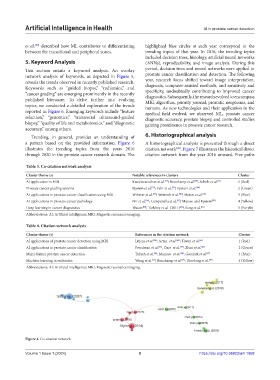
            Figure 4. Co-citation network.


            Volume 1 Issue 1 (2024)                         8                         https://doi.org/10.36922/aih.1958

