


Page 12 - AIH-1-1
P. 12
Artificial Intelligence in Health                                           AI in prostate cancer detection


               80                                              For our analysis, we utilized tools such as the Bibliometrix
                                                        71     R-package  and VOSviewer . The resulting cluster adheres
                                                                                     [29]
                                                                       [28]
               70                                     65       to a widely used approach based on centrality criterion.
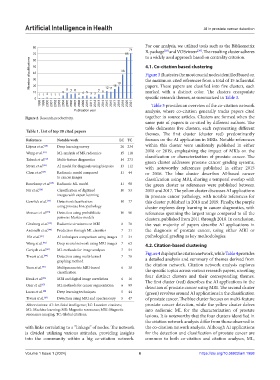
              Number of publications  50             38        4.1. Co-citation based clustering
               60
               40
                                                               Figure 3 illustrates the most crucial nodes identified based on
               30
                                                               the maximum cited references from a total of 15 influential
               20
                                                               marked  with  a  distinct  color.  The  clusters  encapsulate
               10           5  9  7 8  4 5  7 6  12 11  15 19  papers. These papers are classified into five clusters, each
                 11 2 11 1        2    33
                0                                              specific research themes, as summarized in Table 3.
                  1998  1999  2000  2001  2002  2003  2004  2005  2006  2007  2008  2009  2010  2011  2012  2013  2014  2015  2016  2017  2018  2019  2020  2021  Table 3 provides an overview of the co-citation network
                                 Publication year              analysis, where co-citation generally tracks papers cited
            Figure 2. Research productivity.                   together in source articles. Clusters are formed when the
                                                               same pair of papers is co-cited by different authors. The
                                                               table delineates five clusters, each representing different
            Table 1. List of top 20 cited papers
                                                               themes. The first cluster (cluster red) predominantly
            Reference    Notable work               LC TC      focuses on the AI application in MRIs. Notable references
            Litjens et al. [30]  Deep learning survey  20 234  within  this  cluster  were  uniformly  published  in  either
            Wang et al. [31]  ML analysis of MR radiomics  15 118  2018 or 2019, emphasizing the impact of MRIs on the
                                                               classification or characterization of prostate cancer. The
                    [32]
            Tabesh et al.    Multi-feature diagnostics  14 273  green cluster addresses prostate cancer grading systems,
            Strom et al.    AI model for diagnosis using biopsies  13 112  with noteworthy references published in either 2015
                   [33]
            Chen et al. [34]  Radiomic model compared    11  44  or 2016. The blue cluster describes AI-based cancer
                         to cancer images                      classification using MRI, sharing a temporal overlap with
            Bonekamp et al. [35]  Radiomic ML model  11  98    the green cluster as references were published between
            Nir et al. [36]  Classification of digitized    10  53  2015 and 2017. The yellow cluster discusses AI applications
                         images with expert learning           in prostate cancer pathology, with notable references for
                     [37]
            Gorelick et al.    Detection/classification    10  77  this cluster published in 2018 and 2019. Finally, the purple
                         using prostate histopathology         cluster explores deep learning in cancer diagnostics, with
            Monaco et al. [38]  Detection using probabilistic    10  90  references spanning the largest range compared to all the
                         pairwise Markov models                clusters, published from 2011 through 2018. In conclusion,
            Ginsburg et al.    Radiomic structures on MRI  8  78  the  vast majority of  papers describe AI  applications in
                      [39]
            Antonelli et al.    Prediction through ML classifier  7  31  the  diagnosis  of  prostate  cancer,  using  either  MRI  or
                      [40]
             Nir et al. [41]  AI techniques comparison using images  7  34  pathological grading as key methodologies.
            Wang et al. [42]  Deep neural network using MRI images  7  63  4.2. Citation-based clustering
                     [43]
            Gertych et al.    ML methods for image analyses  7  54  Figure 4 displays the citation network, while Table 4 provides
            Tiwari et al.    Detection using multi-kernel    7  78  a detailed analysis and summary of themes derived from
                    [44]
                         graphing method
            Yuan et al.    Multiparametric MRI-based   6  38   the citation network. Citation network analysis explores
                   [45]
                         classification                        the specific topics across various research papers, unveiling
            Kwak et al.    MRI and digital image correlation  6  16  four distinct clusters and their corresponding themes.
                   [46]
                                                               The first cluster (red) describes the AI applications in the
            Ozer et al. [47]  ML methods for cancer segmentation  6  99  detection of prostate cancer using MRI. The second cluster
            Lucas et al.    Deep learning techniques  5  44    (green) revolves around AI applications in the classification
                   [48]
            Tiwari et al. [49]  Detection using MRI and spectroscopy  5  47  of prostate cancer. The blue cluster focuses on multi-feature
            Abbreviations: AI: Artificial intelligence; LC: Location citations;    prostate cancer detection, while the yellow cluster delves
            ML: Machine learning; MR: Magnetic resonance; MRI: Magnetic   into radiomic ML for the characterization of prostate
            resonance imaging; TC: Global citations.           lesions. It is noteworthy that the four clusters identified in
                                                               the citation network analysis differ from those observed in
            with links correlating to a ”linkage” of nodes. The network   the co-citation network analysis. Although AI applications
            is divided utilizing various attitudes, providing insights   for the detection and classification of prostate cancer are
            into the community within a big co-citation network.   common to both co-citation and citation analyses, ML,


            Volume 1 Issue 1 (2024)                         6                         https://doi.org/10.36922/aih.1958

