


Page 133 - AIH-1-2
P. 133
Artificial Intelligence in Health                                              SDoH in clinical narratives


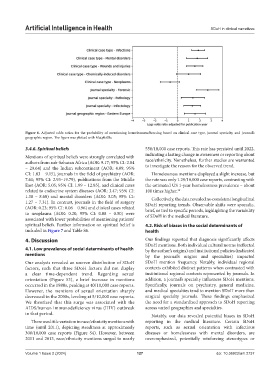
            Figure  6. Adjusted odds ratios for the probability of mentioning homelessness/housing based on clinical case type, journal specialty, and journal’s
            geographic region. The figure was plotted with Matplotlib.

            3.4.6. Spiritual beliefs                           550/10,000 case reports. This rate has persisted until 2022,
                                                               indicating a lasting change in awareness or reporting about
            Mentions of spiritual beliefs were strongly correlated with   race/ethnicity. Nonetheless, further studies are warranted
            authors from sub-Saharan Africa (AOR: 9.17; 95% CI: 2.84
            – 29.64) and the Indian subcontinent (AOR: 4.09; 95%   to investigate the reason for the observed trend.
            CI: 1.83 – 9.15), journals in the field of psychiatry (AOR:   Homelessness mentions displayed a slight increase, but
            7.61; 95% CI: 2.93–19.79), publications from the Middle   the rate was only 1.29/10,000 case reports, contrasting with
            East (AOR: 5.05; 95% CI: 1.99 – 12.85), and clinical cases   the estimated US 1-year homelessness prevalence – about
            related to endocrine system diseases (AOR: 3.47; 95% CI:   100 times higher. 36
            1.38 – 8.68) and mental disorders (AOR: 3.05; 95% CI:   Collectively, the data revealed no consistent longitudinal
            1.27 – 7.31). In contrast, journals in the field of surgery   SDoH reporting trends. Observable shifts were sporadic,
            (AOR: 0.23; 95% CI: 0.06 – 0.96) and clinical cases related   brief, or tied to specific periods, highlighting the variability
            to neoplasms (AOR: 0.20; 95% CI: 0.08 – 0.50) were   of SDoH in the medical literature.
            associated with lower probabilities of mentioning patients’
            spiritual beliefs. Further information on spiritual belief is   4.2. Risk of biases in the social determinants of
            included in Figure 7 and Table S6.                 health

            4. Discussion                                      Our findings reported that diagnosis significantly affects
                                                               SDoH mentions. Both individual cultural norms (reflected
            4.1. Low prevalence of social determinants of health   by the author’s origins) and institutional policies (indicated
            mentions                                           by the journal’s origins and specialties) impacted
            Our analysis revealed an uneven distribution of SDoH   SDoH mention frequency. Notably, individual regional
            factors, such that three SDoH factors did not display   contexts exhibited distinct patterns when contrasted with
            a clear time-dependent trend. Regarding sexual     institutional regional contexts represented by journals. In
            orientation (Figure S3), a brief increase in mentions   addition, a journal’s specialty influences SDoH mentions.
            occurred in the 1980s, peaking at 40/10,000 case reports.   Specifically, journals on psychiatry, general medicine,
            However, the  mentions  of sexual  orientation  sharply   and medical specialties tend to mention SDoH more than
            decreased in the 2000s, leveling at 5/10,000 case reports.   surgical specialty journals. These findings emphasized
            We theorized that this surge was associated with the   the need for a standardized approach to SDoH reporting
            AIDS/human immunodeficiency virus (HIV) outbreak   across varied geographies and specialties.
            in that period.                                      Notably, our data revealed potential biases in SDoH

              There was little variation in race/ethnicity mentions with   reporting in the medical literature. Certain SDoH
            time (until 2011), depicting steadiness at approximately   reports, such as sexual orientation with infectious
            300/10,000  case reports (Figure S4). However, between   diseases or homelessness with mental disorders, are
            2011 and 2013, race/ethnicity mentions surged to nearly   overemphasized, potentially reinforcing stereotypes or


            Volume 1 Issue 2 (2024)                        127                               doi: 10.36922/aih.2737

