


Page 31 - AIH-1-2
P. 31
Artificial Intelligence in Health                                LLMs-Healthcare: Application and challenges


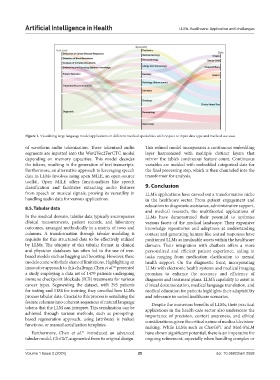
            Figure 1. Visualizing large language model applications in different medical specialities with respect to input data type and medical use-case.

            of waveform audio tokenization. These tokenized audio   This refined model incorporates a continuous embedding
            segments are inputted into the Wav2Vec2ForCTC model   layer harmonized with multiple distinct layers that
            depending on memory capacities. This model decodes   mirror  the  table’s continuous  feature count. Continuous
            the tokens, resulting in the generation of text transcripts.   variables are melded with embedded categorical data for
            Furthermore, an alternative approach to leveraging speech   the final processing step, which is then channeled into the
            data in LLMs involves using open MILE, an open-source   transformer for analysis.
            toolkit. Open  MILE offers  functionalities like speech
            classification and facilitates extracting audio features   9. Conclusion
            from speech or musical signals, proving its versatility in   LLM’s applications have carved out a transformative niche
            handling audio data for various applications.      in the healthcare sector. From patient engagement and
                                                               education to diagnostic assistance, administrative support,
            8.5. Tabular data
                                                               and medical research, the multifaceted applications of
            In the medical domain, tabular data typically encompasses   LLMs have demonstrated their potential to optimize
            clinical measurements, patient records, and laboratory   various facets of the medical landscape. Their expansive
            outcomes, arranged methodically in a matrix of rows and   knowledge repositories and adeptness at understanding
            columns. A  transformation through tabular modeling is   context and generating human-like textual responses have
            requisite for this structured data to be effectively utilized   positioned LLMs as invaluable assets within the healthcare
            by LLMs. The ubiquity of this tabular format in clinical   domain.  Their  integration  with  chatbots  offers  a  more
            and physician databases has often led to the use of tree-  personalized and efficient patient experience, aiding in
            based models such as bagging and boosting. However, these   tasks ranging from medication clarification to mental
            models come with their share of limitations. Highlighting an   health support. On the diagnostic front, incorporating
            innovative approach to this challenge, Chen et al.  presented   LLMs with electronic health systems and medical imaging
                                                 41
            a study employing a data set of 1479 patients undergoing   promises to enhance the accuracy and efficiency of
            immune checkpoint blockade (ICB) treatments for various   diagnosis and treatment plans. LLM’s capability to assist in
            cancer  types.  Segmenting  the  dataset,  with  295  patients   clinical documentation, medical language translation, and
            for testing and 1184 for training, they unveiled how LLMs   medical education for patients highlights their adaptability
            process tabular data. Crucial to this process is serializing the   and relevance in varied healthcare scenarios.
            feature columns into coherent sequences of natural language   Despite the numerous benefits of LLMs, their practical
            tokens that the LLM can interpret. This serialization can be   applications in the health-care sector also underscore the
            achieved  through  various  methods,  such  as prompting-  importance of precision, context awareness, and ethical
            based regeneration approach, using {attribute} is {value}   considerations, given the critical nature of medical decision-
            functions, or manual serialization templates.      making. While LLMs such as ChatGPT and Med-PaLM
              Furthermore, Chen  et al.  introduced an advanced   have shown significant potential, there is an imperative for
                                    41
            tabular model, ClinTaT, augmented from its original design.   ongoing refinement, especially when handling complex or

            Volume 1 Issue 2 (2024)                         25                               doi: 10.36922/aih.2558

