


Page 136 - AIH-1-3
P. 136
Artificial Intelligence in Health                                    ADRD caregiver experiences on Reddit


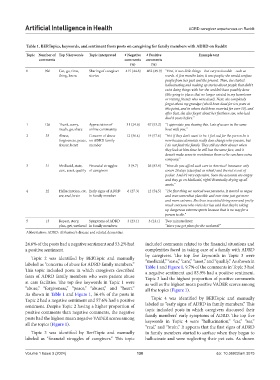
            Table 1. BERTopics, keywords, and sentiment from posts on caregiving for family members with ADRD on Reddit
            Topic Number of  Top 5 keywords  Topic interpreted  # Negative   # Positive   Example text
                  comments                            comments   comments
                                                        (%)      (%)
            0       926   Get, go, time,   Sharing of caregiver   415 (44.8)  462 (49.9) “First, it was little things – but very noticeable – such as
                          thing, know  stories                         words. A few months later, it was people; she would confuse
                                                                       people from her past and the present. Then, she started
                                                                       hallucinating and making up stories about people that didn’t
                                                                       exist doing things with her she couldn’t have possibly done
                                                                       (like going to places that no longer existed in my hometown
                                                                       or visiting friends who were dead). Next, she completely
                                                                       forgot about my grandpa (who’d been dead for ten years at
                                                                       this point, and to whom she’d been married for over 50), and
                                                                       after that, she also forgot about her firstborn son, who had
                                                                       died 8 years before.”
            1       126   Thank, sorry,   Appreciation of   31 (24.6)  67 (53.2)  “I appreciate you sharing this. Lots of us are in the same
                          much, go, share  online community            boat with you.”
            2       33    Abuse,       Concern of abuse   12 (36.4)  19 (57.6)  “Not if they don’t want to be. I feel sad for the person he is
                          forgiveness, peace,  on ADRD family          now because dementia really does change who you are, but
                          abuser, heart  member                        I do not fault the family. They still see their abuser when
                                                                       they look at him since he still has the same face, and it
                                                                       doesn’t make sense to revictimize them so he can have extra
                                                                       company.”
            3       31    Medicaid, state,   Financial struggles   3 (9.7)  26 (83.9)  “How do you afford such care in America? Insurance only
                          care, asset, qualify of caregivers           covers 28 days (classified as rehab) and the rest is out of
                                                                       pocket. And it’s very expensive. Soon the accounts are empty
                                                                       and they go on Medicaid, right? Eventually drying up all
                                                                       assets.”
            4       22    Hallucination, cat,  Early signs of ADRD   6 (27.3)  12 (54.5)  “The first thing we noticed was paranoia. It started as vague
                          see, real, brain  in family member           and even somewhat plausible and over time just got more
                                                                       and more extreme. She lives in assisted living now and pretty
                                                                       much everyone who visits her has said that they’re taking
                                                                       up dangerous extreme sports because that is no way for a
                                                                       person to die.”
            5       13    Repeat, story,   Symptoms of ADRD   3 (23.1)  3 (23.1)  Two minutes later:
                          plan, get, weekend in family members         “Have you got plans for the weekend?”
            Abbreviation: ADRD: Alzheimer’s disease and related dementias.

            24.6% of the posts had a negative sentiment and 53.2% had   included comments related to the financial situations and
            a positive sentiment.                              complexities faced in taking care of a family with ADRD
                                                               by caregivers. The top five keywords in Topic 3 were
              Topic 2 was identified by BERTopic and manually   “medicaid,” “state,” “care,” “asset,” and “qualify.” As shown in
            labeled as “concerns of abuse for ADRD family members.”   Table 1 and Figure 1, 9.7% of the comments in Topic 3 had
            This topic included posts in which caregivers described   a negative sentiment and 83.9% had a positive sentiment.
            fears of ADRD family members who were patient abuse   Topic 3 had the highest proportion of positive comments
            at care facilities. The top five keywords in Topic 1 were   as well as the highest mean positive VADER scores among
            “abuse,” “forgiveness,” “peace,” “abuser,” and “heart.”   all the topics (Figure 1).
            As shown in Table 1 and Figure 1, 36.4% of the posts in
            Topic 2 had a negative sentiment and 57.6% had a positive   Topic 4 was identified by BERTopic and manually
            sentiment. Despite Topic 2 having a higher proportion of   labeled as “early signs of ADRD in family members.” This
            positive comments than negative comments, the negative   topic included posts in which caregivers discussed their
            posts had the highest mean negative VADER scores among   family members’ early symptoms of ADRD. The top five
                                                               keywords in Topic 4 were “hallucination,” “cat,”  “see,”
            all the topics (Figure 1).
                                                               “real,” and “brain.” It appears that the first signs of ADRD
              Topic  3  was  identified  by  BertTopic  and  manually   in family members started to surface when they began to
            labeled as “financial struggles of caregivers.” This topic   hallucinate and were neglecting their pet cats. As shown


            Volume 1 Issue 3 (2024)                        130                               doi: 10.36922/aih.3075

