


Page 63 - AIH-1-3
P. 63
Artificial Intelligence in Health                                       ChatGPT in writing scientific articles


                         A                                   B


                         C                                   D


                         E                                    F


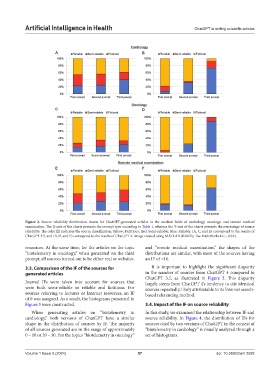
            Figure  2. Source reliability distribution  charts for ChatGPT-generated articles in the medical fields of cardiology, oncology, and remote medical
            examination. The X-axis of the charts presents the prompt type according to Table 1, whereas the Y-axis of the charts presents the percentage of source
            reliability. The color fill indicates the source classification: Yellow: Fictitious; Red: Semi-reliable; Blue: Reliable. (A, C, and E) correspond to the results of
            ChatGPT 3.5, and (B, D, and F) correspond to the results of ChatGPT 4. Image created using MATLAB (R2021b, The MathWorks Inc., USA).

            resources. At the same time, for the articles on the topic   and “remote medical examination,” the shapes of the
            “biotelemetry in oncology,” when generated on the third   distributions are similar, with most of the sources having
            prompt, all sources turned out to be either real or websites.  an IF of <10.
            3.3. Comparison of the IF of the sources for         It is important to highlight the significant disparity
            generated articles                                 in the number of sources from ChatGPT 4 compared to
                                                               ChatGPT 3.5, as illustrated in  Figure  3. This disparity
            Journal IFs were taken into account for sources that   largely stems from ChatGPT 4’s tendency to cite identical
            were both semi-reliable or reliable and fictitious. For   sources repeatedly, likely attributable to its Internet search-
            sources referring to lectures or Internet resources, an IF   based referencing method.
            of 0 was assigned. As a result, the histograms presented in
            Figure 3 were constructed.                         3.4. Impact of the IF on source reliability
              When generating articles on “biotelemetry in     In this study, we examined the relationship between IF and
            cardiology,” both versions of ChatGPT have a similar   source reliability. In Figure 4, the distribution of IFs for
            shape  in the distribution of sources  by IF. The majority   sources cited by two versions of ChatGPT in the context of
            of all sources generated are in the range of approximately   “biotelemetry in cardiology” is visually analyzed through a
            0 – 10 or 20 – 30. For the topics “biotelemetry in oncology”   set of histograms.


            Volume 1 Issue 3 (2024)                         57                               doi: 10.36922/aih.2592

