


Page 62 - AIH-1-3
P. 62
Artificial Intelligence in Health                                       ChatGPT in writing scientific articles


               publishing journal names. These are real sources that   3.2. Comparison of source reliability for generated
               can theoretically be used in the preparation of an   articles
               article on the specified topics.                The total number of sources used for generating scientific
            (ii)  Semi-reliable sources (“red”): These sources have a   articles on the topic of biotelemetry in cardiology was
               real title of the article but incorrect publication year,   260  (155 for ChatGPT 3.5 and 105 for ChatGPT 4).
               journal, and/or authors’ names. The “red” group also   For articles generated on the topic of biotelemetry in
               included  Internet  sources  (websites  of  biomedical   oncology, the neural network produced 269 sources (157
               companies, Wikipedia, and others). Such online   for ChatGPT 3.5 and 112 for ChatGPT 4). For articles on
               sources were actively cited by ChatGPT 4 when it was   the topic of biotelemetry in remote medical examination,
               unable to find other journal publications. It is worth   246 (150 for ChatGPT 3.5 and 96 for ChatGPT 4) sources
               noting that all the “red” sources for this version turned
               out to be Internet sources.                     were obtained.
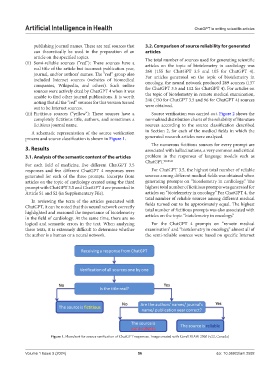
            (iii) Fictitious sources (“yellow”): These sources have a   Source verification was carried out. Figure 2 shows the
               completely fictitious title, authors, and sometimes a   normalized distribution charts of the reliability of literature
               fictitious journal name.                        sources according to the source classification described
              A  schematic representation of the source verification   in Section 2, for each of the medical fields in which the
            process and source classification is shown in Figure 1.  generated research articles were analyzed.
                                                                 The numerous fictitious sources for every prompt are
            3. Results                                         associated with hallucinations, a very common and critical
            3.1. Analysis of the semantic content of the articles  problem in the responses of language models such as
                                                               ChatGPT. 28,40,41
            For each field of medicine, five different ChatGPT 3.5
            responses  and five different ChatGPT 4 responses  were   For ChatGPT 3.5, the highest total number of reliable
            generated for each of the three prompts. Excerpts from   sources among different medical fields was obtained when
            articles on the topic of cardiology created using the third   generating prompts on “biotelemetry in cardiology.” The
            prompt with ChatGPT 3.5 and ChatGPT 4 are presented in   highest total number of fictitious prompts was generated for
            Article S1 and S2 (in Supplementary File).         articles on “biotelemetry in oncology.” For ChatGPT 4, the
                                                               total number of reliable sources among different medical
              In reviewing the texts of the articles generated with
            ChatGPT, it can be noted that this neural network correctly   fields turned out to be approximately equal. The highest
                                                               total number of fictitious prompts was also associated with
            highlighted and reasoned the importance of biotelemetry   articles on the topic “biotelemetry in oncology.”
            in the field of cardiology. At the same time, there are no
            logical and semantic errors in the text. When analyzing   For  the  ChatGPT  4  prompts  on  “remote  medical
            these texts, it is extremely difficult to determine whether   examination” and “biotelemetry in oncology,” almost all of
            the author is a human or a neural network.         the semi-reliable sources were based on specific Internet


                       Figure 1. Flowchart for source verification of ChatGPT responses. Image created with CorelDRAW 2020 (v22, Canada)


            Volume 1 Issue 3 (2024)                         56                               doi: 10.36922/aih.2592

