


Page 90 - AIH-1-3
P. 90
Artificial Intelligence in Health                                 Dental cavity prediction with computer vision


              Applying these augmentation techniques expanded
            the dataset to a total of 2383 images, thereby facilitating a
            richer and more comprehensive training process.

            3.1.3. Manual annotation process
            Following the augmentation phase, we proceeded with the
            manual annotation of dental cavities within the augmented
            images.  For  this  purpose,  we  employed  the  Roboflow
            annotation tool, which facilitated meticulous annotation
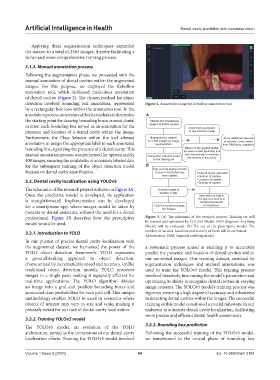
            of dental cavities (Figure 2). The chosen method for object
            detection involved bounding box annotation, represented   Figure 2. Annotation using the Roboflow annotation tool
            by a rectangular box icon within the annotation tool. In the
            annotation process, annotators utilized crosshairs to determine   A
            the starting point for drawing bounding boxes around dental   Utilized 218 smartphone
            cavities. Each bounding box served as an annotation for the   images of dental cavities.  Optimized parameters
            presence and location of a dental cavity within the image.           of the YOLOv5 model
            Furthermore, the Class  Selector within the tool allowed   Expanded the dataset     As an additional measure
                                                                                                of severity, cavity masks
            annotators to assign the appropriate label to each annotated   to 2,383 images by image  from SAM were evaluated.
                                                                   augmentation.
            bounding box, signifying the presence of a dental cavity. This     the area of each bounding box
                                                                                Based on the applied model,
            manual annotation process was performed for approximately   Trained the YOLOv5 model  was determined, to estimate
            400 images, ensuring the availability of accurately labeled data   on the training set.  the severity of the cavity.
            for the subsequent training of the object detection model   B
            focused on dental cavity identification.              Take several photos of teeth.  YOLOv5 model estimates:
                                                                   Focus on teeth that may
                                                                      have cavities.  • Number of cavities
            3.2. Dental cavity localization using YOLOv5                             • Location of cavities
                                                                                     • Severity of cavities
            The schematic of the research project is shown in Figure 3A.   Upload images to
            Once the predictive model is developed, its application   website or app.  Information is kept in
            is  straightforward.  Implementation  can  be  developed                 the app or is sent to a
                                                                                      dental professional
            for a smartphone app, where images would be taken by   YOLOv5 model evaluates  for treatment.
                                                                      the images.
            patients or dental assistants, without the need for a dental
            professional.  Figure  3B describes how the prescriptive   Figure  3. (A) The schematic of the research project. Training set will
            model would be used.                               be trained and optimized by YOLOv5 Model. SAM (Segment Anything
                                                               Model) will be evaluated. (B) The use of the prescriptive model. The
            3.2.1. Introduction to YOLO                        number of cavities, locations and severity of them will be estimated.
                                                               Abbreviation: SAM: Segment anything model.
            In our pursuit of precise dental cavity localization with
            the augmented dataset, we harnessed the power of the   a systematic process aimed at enabling it to accurately
            YOLO object detection framework. YOLO represents   predict the presence and location of dental cavities within
            a groundbreaking approach to object detection,     our annotated images. Our training dataset, enriched by
            characterized by its remarkable speed and accuracy. Unlike   augmentation techniques and manual annotations, was
            traditional  object  detection  models,  YOLO  processes   used  to train the  YOLOv5 model.  This  training  process
            images in a single pass, making it especially efficient for   involved iteratively fine-tuning the model’s parameters and
            real-time applications. The YOLO algorithm divides   optimizing its ability to recognize dental cavities in varying
            an image into a grid and predicts bounding boxes and   image contexts. The YOLOv5 model’s training process was
            associated class probabilities for each grid cell. This unique   rigorous, ensuring a high degree of accuracy and robustness
            methodology enables YOLO to excel in scenarios where   in detecting dental cavities within the images. The successful
            objects of interest may vary in size and scale, making it   training of this model constituted a crucial milestone in our
            precisely suited for our task of dental cavity localization.  endeavor to automate dental cavity localization, facilitating
                                                               more precise and efficient dental health assessments.
            3.2.2. Training YOLOv5 model
            The YOLOv5 model, an evolution of the YOLO         3.2.3. Bounding box prediction
            architecture, served as the cornerstone of our dental cavity   Following the successful training of the YOLOv5 model,
            localization efforts. Training the YOLOv5 model involved   we transitioned to the crucial phase of bounding box


            Volume 1 Issue 3 (2024)                         84                               doi: 10.36922/aih.3184

