


Page 92 - AIH-1-3
P. 92
Artificial Intelligence in Health                                 Dental cavity prediction with computer vision


              The data in this study are based on image augmentation
            imitating multiple possible alternatives for each
            original image. While we believe that this is an accurate
            representation of future images that will be available,
            it would be more effective to have actual images from
            multiple angles for teeth and cavities.
              More broadly, as AI is applied to more diverse   Figure 6. Source image and segmented image
            opportunities in modeling and medical diagnostics, several
            issues may emerge. These relate both to the development
            of new models and the use of automated diagnostics by
            individuals and  medical  professionals. On  the  modeling
            side, one can foresee, in the not-too-distant future, the
            possibility of automated modeling being employed,
            evaluating a broad set of models on a given dataset. Without
            supervision and effective parameter tuning, these methods
            could lead to overfitting or the use of inappropriate models.
            Similarly, the data used for these automated studies could
            be suspect. Using available images that are not evaluated
            by people could be unreliable. Imagine a situation where
            an autonomous model is developed by images created by
            AI, for example.
              The implications of AI on medical practice should also   Figure 7. Mask image of the cavity
            be considered. Applications like the one proposed here
            provide effective but limited self-diagnosing opportunities   The SAM is also highly efficient, making it suitable for real-
            to individuals, especially in areas with limited access to   time applications. It can generate a segmentation mask for
            health. However, it is likely that some people who could   any prompt in real time after precomputing the image
            receive effective diagnoses from medical professionals   embedding.
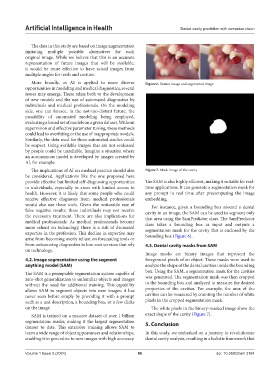
            would also use these tools. Given the noticeable rate of   For instance, given a bounding box around a dental
            false negative results, these individuals may not receive   cavity in an image, the SAM can be used to segment only
            the necessary treatment. There are also implications for   that area using the SamPredictor class. The SamPredictor
            medical professionals. As medical professionals become   class takes a bounding box as input and outputs a
            more reliant on technology, there is a risk of decreased   segmentation mask for the cavity that is enclosed by the
            expertise in the profession. This decline in expertise may   bounding box (Figure 6).
            arise from becoming overly reliant on forecasting tools or
            from outsourcing diagnostics to low-cost services that rely   4.3. Dental cavity masks from SAM
            on technology.
                                                               Image masks are binary images that represent the
            4.2. Image segmentation using the segment          foreground pixels of an object. These masks were used to
            anything model (SAM)                               analyze the shape of the dental cavities inside the bounding
            The SAM is a promptable segmentation system capable of   box. Using the SAM, a segmentation mask for the cavities
            zero-shot generalization to unfamiliar objects and images   was generated. The segmentation mask was then cropped
            without  the  need  for  additional  training.  This  capability   to the bounding box and analyzed to measure the desired
            allows SAM to segment objects into new images; it has   properties of the cavities. For example, the area of the
            never seen before simply by providing it with a prompt   cavities can be measured by counting the number of white
            such as a text description, a bounding box, or a few clicks   pixels in the cropped segmentation mask.
            on the image.                                        The white pixels in the binary-masked image show the
              SAM is trained on a massive dataset of over 1 billion   exact shape of the cavity (Figure 7).
            segmentation masks, making it the largest segmentation   5. Conclusion
            dataset to date. This extensive training allows SAM to
            learn a wide range of object appearances and relationships,   In this study, we embarked on a journey to revolutionize
            enabling it to generalize to new images with high accuracy.   dental cavity analysis, resulting in a holistic framework that


            Volume 1 Issue 3 (2024)                         86                               doi: 10.36922/aih.3184

