


Page 91 - AIH-1-3
P. 91
Artificial Intelligence in Health                                 Dental cavity prediction with computer vision


            prediction and post-processing. This step represents the
            culmination of our efforts to precisely locate dental cavities
            within  unknown  images,  a process  that significantly
            contributes to the automation of dental health assessment.
            The  YOLOv5  model,  trained  on  our  annotated  dataset,
            acquired the capability to predict bounding boxes around
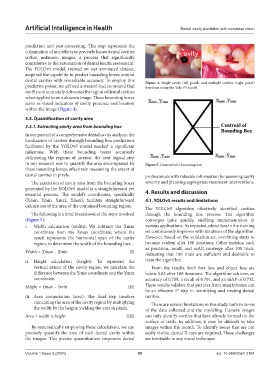
            dental cavities with remarkable accuracy. To employ this   Figure  4.  Single  cavity  (left  panel)  and  multiple  cavities  (right panel)
            predictive power, we utilized a streamlined command that   detection using the Yolo V5 model
            swiftly and accurately delineates the region of dental cavities
            when applied to an unknown image. These bounding boxes
            serve as visual indicators of cavity presence and location
            within the image (Figure 4).

            3.3. Quantification of cavity area
            3.3.1. Extracting cavity area from bounding box
            In our pursuit of a comprehensive dental cavity analysis, the
            localization of cavities through bounding box predictions
            facilitated by the YOLOv5 model marked a significant
            milestone.  With  these  bounding  boxes  accurately
            delineating the regions of interest, the next logical step
            in our research was to quantify the area encompassed by   Figure 5. Centroid of a bounding box
            these bounding boxes, effectively measuring the extent of
            dental cavities in pixels.                         professionals with valuable information for assessing cavity
              The extraction of cavity area from the bounding boxes   severity and planning appropriate treatment interventions.
            generated by the YOLOv5 model is a straightforward yet
            essential process. The model’s coordinates, specifically   4. Results and discussion
            (Xmin, Ymin, Xmax, Ymax), facilitate straightforward   4.1. YOLOv5 results and limitations
            calculation of the area of the contained bounding region.
                                                               The YOLOv5 algorithm effectively identified cavities
              The following is a brief breakdown of the steps involved   through the bounding box process. The algorithm
            (Figure 5):                                        converges  quite  quickly,  enabling  implementation  in
            i.   Width  calculation (width): We  subtract  the  Xmin   various applications. As expected, object loss in the training
               coordinate from the Xmax coordinate, where the   set continuously improves with iterations of the algorithm.
               result represents the horizontal span of the cavity   However, based on the validation set, overfitting starts to
               region, to determine the width of the bounding box.  become evident after 100 iterations. Other metrics, such
                                                               as precision, recall, and mAP, converge after 100 trials,
            Width = Xmax – Xmin                         (I)    indicating that 100 trials are sufficient and desirable to

            ii.  Height calculation (height): To represent the   train the algorithm.
               vertical extent of the cavity region, we calculate the   From the results, both box loss and object loss are
               difference between the Ymin coordinate and the Ymax   below 0.03 after 100 iterations. The algorithm achieves an
               coordinate.                                     accuracy of 0.789, a recall of 0.701, and an mAP of 0.732.
            Height = Ymax – Ymin                       (II)    These results validate that pictures from smartphones can
                                                               be an effective 1  step in identifying and treating dental
                                                                            st
            iii.  Area computation (area): The final step involves   cavities.
               calculating the area of the cavity region by multiplying   There are several limitations in this study, both in terms
               the width by the height, yielding the area in pixels.  of  the data collected  and the  modeling. Camera images
            Area = width × height                      (III)   can only identify cavities that have already formed on the
                                                               surface of teeth. In addition, it may be difficult to take
              By systematically employing these calculations, we can   images within the mouth. To identify issues that are not
            precisely quantify the area  of  each  dental  cavity  within   easily visible, dental X-rays are required. These challenges
            the images. This precise quantification empowers dental   are inevitable in any visual technique.


            Volume 1 Issue 3 (2024)                         85                               doi: 10.36922/aih.3184

