


Page 89 - AIH-1-3
P. 89
Artificial Intelligence in Health                                 Dental cavity prediction with computer vision


            of bitewing images in clearly capturing such lesions.    heralding a new era of precision and efficiency in detecting
                                                         19
            Another  innovative  approach  involved  classifying  tooth   dental caries. As we delve further into this article, we
            caries using quantitative light-induced fluorescence (QLF)   will explore the mechanics behind these innovations,
            images with the help of the Xception deep learning model,   their practical applications, and the challenges and
            underscoring the significance of image augmentation   future  directions  in  integrating  advanced  computational
            and K-fold cross-validation in training robust models.    techniques into dental care.
                                                         20
            A systematic review aimed at evaluating neural networks
            in caries detection highlighted the diverse methodologies   3. Methods
            and neural network architectures employed across studies,   3.1. Data collection and pre-processing
            reflecting the dynamic evolution of AI applications in
            dental diagnostics. 21                             The image data were sourced from Kaggle (https://
                                                               www.kaggle.com/datasets/salmansajid05/oral-
              Further illustrating the potential of machine learning   diseases?resource=download-directory).  This  dataset
            in dentistry, a previous study applied several algorithms,   comprises a collection of images obtained from multiple
            notably random forest, achieving high performance in   health  centers  and  reliable  dental  websites,  ensuring  the
            predicting the risk of dental caries from a dataset derived   variety and validity of the dental conditions depicted. Each
                                         22
            from a children’s oral health survey.  A systematic review   image in the dataset is thoroughly marked with bounding
            focusing  on  AI  for  radiographic  imaging  detection  of   boxes, accurately representing the dental condition.
            caries lesions critically evaluated studies, revealing a
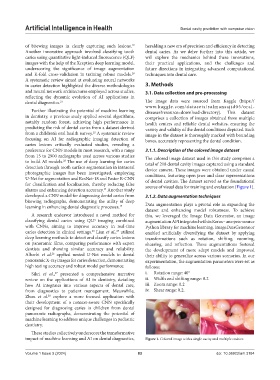
            preference for CNN models in most research, with a range   3.1.1. Description of the colored image dataset
            from 15 to 2900 radiographs used across various studies   The colored image dataset used in this study comprises a
            to build AI models.  The use of deep learning for caries   total of 218 dental cavity images captured using a standard
                            23
            detection through tooth surface segmentation in intraoral   device camera. These images were obtained under casual
            photographic images has been investigated, employing   conditions, featuring open jaws and clear representations
            U-Net for segmentation and ResNet-18 and Faster R-CNN   of dental cavities. The dataset served as the foundational
            for classification and localization, thereby reducing false   source of visual data for training and evaluation (Figure 1).
            alarms and enhancing detection accuracy.  Another study
                                             24
            developed a CNN model for diagnosing dental caries from   3.1.2. Data augmentation techniques
            bitewing radiographs, demonstrating the utility of deep
            learning in enhancing dental diagnostic processes. 19  Data augmentation plays a pivotal role in expanding the
                                                               dataset and enhancing model robustness. To achieve
              A research endeavor introduced a novel method for   this, we leveraged the Image Data Generator, an image
            classifying  dental caries using  QLF imaging  combined   augmentation API integrated within Keras – an open-source
            with CNNs, aiming to improve accuracy in real-time   Python library for machine learning. ImageDataGenerator
            caries detection in clinical settings.  Lian et al.,  utilized   enabled artificially diversifying the dataset by applying
                                                   25
                                        20
            deep learning methods to detect and classify caries lesions   transformations  such  as  rotation,  shifting,  zooming,
            on panoramic films, comparing performance with expert   shearing, and reflection. These augmentations fostered
            dentists and showing similar accuracy and reliability.   the development of more adept models and improved
            Alharbi  et al.  applied nested U-Net models to dental   their ability to generalize across various scenarios. In our
                       26
            panoramic X-ray images for caries detection, demonstrating   experimentation, the augmentation parameters were set as
            high testing accuracy and robust model performance.  follows:
              Sikri  et al.,  presented a comprehensive narrative   i.   Rotation range: 40°
                        27
            review on the applications of AI in dentistry, detailing   ii.  Width and shifting range: 0.2
            how  AI integrates  into  various  aspects of  dental  care,   iii.  Zoom range: 0.2
            from  diagnostics  to  patient  management.  Meanwhile,   iv.  Shear range: 0.2.
            Zhou  et al.   explore  a  more  focused  application  with
                     28
            their development of a context-aware CNN specifically
            designed  for  diagnosing  caries  in  children  from  dental
            panoramic radiographs, demonstrating the potential of
            machine learning to address unique challenges in pediatric
            dentistry.
              These studies collectively underscore the transformative
            impact of machine learning and AI on dental diagnostics,   Figure 1. Colored image with a single cavity and multiple cavities


            Volume 1 Issue 3 (2024)                         83                               doi: 10.36922/aih.3184

