


Page 39 - AIH-1-4
P. 39
Artificial Intelligence in Health                             Segmentation and classification of DR using CNN


                                                               MA segmentation, optical disc segmentation, and SE
                                                               segmentation. Each lesion is represented as either true
                                                               (present) or false (absent) in the binary inputs. In addition,
                                                               string inputs are generated from a classification or image
                                                               grading model, offering insights into the DR stage classified
                                                               as classes 0 through 4. The amalgamation of binary and
                                                               string inputs forms a robust dataset that is processed by
                                                               ChatGPT, a pre-trained LLM. ChatGPT interprets and
                                                               synthesizes this diverse information to generate nuanced
                                                               test/treatment recommendations, contributing to a
                                                               sophisticated decision-support system that factors in both
                                                               the detailed visual segmentation features and the clinical
                                                               classifications of DR severity. 24
                                                               1.3. Research gap
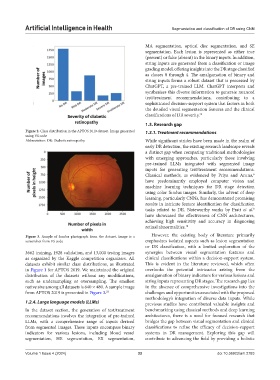
            Figure 2. Class distribution in the APTOS 2019 dataset. Image generated   1.3.1. Treatment recommendations
            using VS code
            Abbreviation: DR: Diabetic retinopathy.            While significant strides have been made in the realm of
                                                               early DR detection, the existing research landscape reveals
                                                               a distinct gap when comparing traditional methodologies
                                                               with emerging approaches, particularly those involving
                                                               pre-trained LLMs integrated with segmented image
                                                               inputs for generating test/treatment recommendations.
                                                               Classical methods, as evidenced by Priya and  Aruna,
                                                                                                             6
                                                               have predominantly employed computer vision and
                                                               machine learning techniques for DR stage detection
                                                               using color fundus images. Similarly, the advent of deep
                                                               learning, particularly CNNs, has demonstrated promising
                                                               results in intricate feature identification for classification
                                                               tasks related to DR. Noteworthy works by Pratt  et al.
                                                                                                             8
                                                               have showcased the effectiveness of CNN architectures,
                                                               achieving high sensitivity and accuracy in diagnosing
                                                               retinal abnormalities. 18
            Figure  3. Sample of fundus photograph from the dataset. Image is a   However, the existing body of literature primarily
            screenshot from VS code                            emphasizes isolated aspects such as lesion segmentation
                                                               or DR classification, with a limited exploration of the
            3662 training, 1928 validation, and 13,000 testing images   synergies between visual segmentation features and
            as organized by the Kaggle competition organizers. All   clinical classifications within a decision-support system.
            datasets exhibit similar class distributions, as illustrated   This  is  evident in  the literature  reviewed,  which  often
            in Figure 1 for APTOS 2019. We maintained the original   overlooks the potential intricacies arising from the
            distribution of  the  datasets  without  any  modifications,   amalgamation of binary indicators for various lesions and
            such as undersampling or oversampling. The smallest   string inputs representing DR stages. The research gap lies
            native size among all datasets is 640 × 480. A sample image   in the absence of comprehensive investigations into the
            from APTOS 2019 is presented in Figure 3. 23       challenges and opportunities associated with the proposed
                                                               methodology’s integration of diverse data inputs. While
            1.2.4. Large language models (LLMs)                previous studies have contributed valuable insights and

            In the dataset section, the generation of test/treatment   benchmarking using classical methods and deep learning
            recommendations involves the integration of pre-trained   architectures, there  is  a need  for  focused research  that
            LLMs, with a comprehensive range of inputs derived   bridges the gap between visual segmentation and clinical
            from segmented images. These inputs encompass binary   classifications to refine the efficacy of decision-support
            indicators for various lesions, including blood vessel   systems in DR management. Exploring this gap will
            segmentation, HE segmentation, EX segmentation,    contribute to advancing the field by providing a holistic


            Volume 1 Issue 4 (2024)                         33                               doi:10.36922/aih.2783

