


Page 42 - AIH-1-4
P. 42
Artificial Intelligence in Health                             Segmentation and classification of DR using CNN


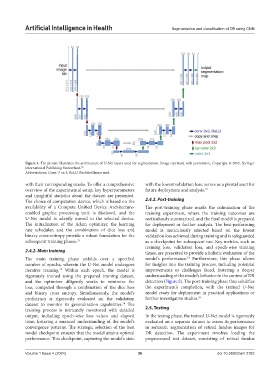
            Figure 4. The picture illustrates the architecture of U-Net layers used for segmentation. Image reprinted with permission, Copyright © 2015, Springer
            International Publishing Switzerland. 38
            Abbreviations: Conv: 3 ×x 3; ReLU: Rectified linear unit.

            with their corresponding masks. To offer a comprehensive   with the lowest validation loss, serves as a pivotal asset for
            overview of the experimental setup, key hyperparameters   future deployment and analysis. 33
            and insightful statistics about the dataset are presented.
            The choice of computation device, which is based on the   2.4.3. Post-training
            availability of a Compute Unified Device Architecture-  The  post-training  phase  marks  the  culmination  of  the
            enabled  graphic  processing  unit,  is  disclosed,  and  the   training experiment, where the training outcomes are
            U-Net model is adeptly moved to the selected device.   meticulously summarized, and the final model is prepared
            The initialization of the Adam optimizer, the learning   for deployment or further analysis. The best-performing
            rate scheduler, and the combination of dice loss and   model is meticulously selected based on the lowest
            binary cross-entropy provide a robust foundation for the   validation loss achieved during training and is safeguarded
            subsequent training phases. 31                     as a checkpoint for subsequent use. Key metrics, such as
                                                               training loss, validation loss, and epoch-wise training
            2.4.2. Main training                               times, are presented to provide a holistic evaluation of the
            The main training phase unfolds over a specified   model’s performance.  Furthermore, this phase allows
                                                                                 18
            number of epochs, wherein the U-Net model undergoes   for insights into the training process, including potential
            iterative training.  Within each epoch, the model is   improvements or challenges faced, fostering a deeper
                          33
            rigorously trained using the prepared training dataset,   understanding of the model’s behavior in the context of DR
            and the optimizer diligently works to minimize the   detection (Figure 5). The post-training phase thus solidifies
            loss,  computed  through  a  combination  of  the dice  loss   the experiment’s completion, with the trained U-Net
            and binary cross entropy. Simultaneously, the model’s   model ready for deployment in practical applications or
            proficiency is rigorously evaluated on the validation   further investigative studies. 34
            dataset to monitor its generalization capabilities.  The
                                                     18
            training process is intricately monitored with detailed   2.5. Testing
            output, including epoch-wise loss values and elapsed   In the testing phase, the trained U-Net model is rigorously
            time, fostering a nuanced understanding of the model’s   evaluated on a separate dataset to assess its performance
            convergence  patterns.  The  strategic  selection  of  the  best   in semantic segmentation of retinal fundus images for
            model checkpoint ensures that the model attains optimal   DR detection. The experiment involves loading the
            performance. This checkpoint, capturing the model’s state   preprocessed test dataset, consisting of retinal fundus


            Volume 1 Issue 4 (2024)                         36                               doi:10.36922/aih.2783

