


Page 44 - AIH-1-4
P. 44
Artificial Intelligence in Health                             Segmentation and classification of DR using CNN


            accuracy  of  positive  predictions,  ranged  from  0.8161  to
            0.8340. The overall accuracy of the model was consistently
            high across all structures, with values ranging from 0.9922
            to 0.9989, as presented in Table 2. These results collectively
            underscored the efficacy of the segmentation model in
            accurately delineating retinal structures, showcasing its
            potential for enhancing diagnostic capabilities in the
            context of retinal pathology assessment.
            3.2. Image grading results

            In our investigation of the APTOS dataset, we thoroughly
            assessed the performance of our proposed method in
            DR grading. Our method exhibited exemplary results,
            achieving  the  highest  accuracy  (ACC)  and  kappa  scores
            among all evaluated methods. Specifically, our approach
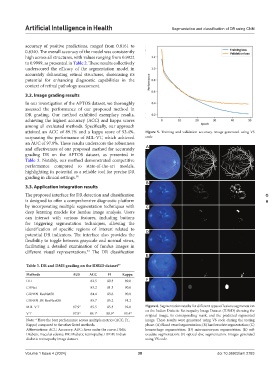
            attained an ACC of 89.1% and a kappa score of 93.4%,   Figure 5. Training and validation accuracy. Image generated using VS
            surpassing the performance of MIL-VT, which achieved   code
            an AUC of 97.9%. These results underscore the robustness
            and effectiveness of our proposed method for accurately   A
            grading DR on the APTOS dataset, as presented in
            Table  3.  Notably, our  method  demonstrated competitive
            performance compared to state-of-the-art models,
            highlighting its potential as a reliable tool for precise DR
            grading in clinical settings. 38
                                                               B
            3.3. Application integration results
            The proposed interface for DR detection and classification                                            G
            is designed to offer a comprehensive diagnostic platform                                              H
            by incorporating multiple segmentation techniques with   C
            deep learning models for fundus image analysis. Users
            can interact with various features, including buttons
            for triggering segmentation techniques, allowing the
            identification of specific regions of interest related to   D
            potential  DR  indicators.  The  interface  also  provides  the
            flexibility to toggle between grayscale and normal views,
            facilitating a detailed examination of fundus images in
                                      34
            different visual representations.  The DR classification
                                                               E
            Table 3. DR and DME grading on the IDRiD dataset 37
            Methods             AUS    ACC     F1    Kappa
            DLI                  -      82.5   80.3   89.0     F
            CANet                -      83.2   81.3   90.0
            GREEN-ResNet50       -      84.4   83.6   90.8
            GREEN-SE-ResNext50   -      85.7   85.2   91.2
            MIL-VT              97.9*   85.5   85.3   92.0     Figure 6. Segmentation results for different types of lesions segmentation
                                                               on the Indian Diabetic Retinopathy Image Dataset (IDRiD) showing the
            VT                  97.9*  89.1*  88.9*   93.4*    original image,  its corresponding  mask, and  the predicted  segmented
            Note: * Have the best performance across multiple metrics (ACC, F1,   image. These results were generated using VS code during the testing
            Kappa) compared to the other listed methods.       phase. (A) Blood vessel segmentation; (B) hard exudate segmentation; (C)
            Abbreviations: ACC: Accuracy; AUC: Area under the curve; DME:   hemorrhage segmentation; (D) microaneurysm segmentation; (E) soft
            Diabetic macular edema; DR: Diabetic retinopathy; IDRiD: Indian   exudate segmentation; (F) optical disc segmentation. Images generated
            diabetic retinopathy image dataset.                using VS code.


            Volume 1 Issue 4 (2024)                         38                               doi:10.36922/aih.2783

