


Page 115 - AIH-2-1
P. 115
Artificial Intelligence in Health                      ML approach for client and program effects in OUD retention


            four had statistically significantly negative treatment effects.   We found that only a small proportion of the sample,
            It is important to note that these four programs with negative   that is, 61 out of 627 OTPs (<10%), would statistically
            treatment effects may potentially represent false discoveries.  significantly benefit from workforce diversity when it comes
                                                               to retaining clients. This means that, notwithstanding
              The comparison of characteristics of these 61 OTPs with
            the other 566 OTPs is presented in Table 2. The 61 OTPs   the level of workforce diversity, characteristics of these
            that would benefit the most from workforce diversity had   programs, other than workforce diversity, would cause
            significantly lower percentages of Black clients (P < 0.001,),   them to benefit more from diversity. The characteristics that
            were more likely to be private-for-profit (P < 0.001), had   amplified the impact of workforce diversity on retention
            lower staff-to-client ratio (P < 0.001), much higher   included: lower percentages of Black clients, lower staff-to-
                                                               client ratio, higher proportion of staff who had graduate
            proportion of staff who had graduate degrees (P < 0.001),   degrees, and lower percentage of unemployed clients. In
            much lower percentage of unemployed clients (P < 0.001),
            and were more likely to be newer programs (P < 0.001).   addition, those OTPs were more likely to be private for-
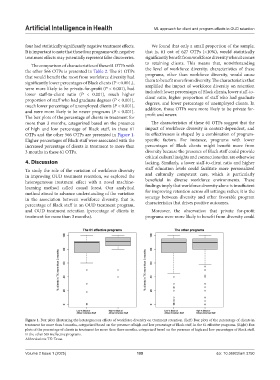
            The box plots of the percentage of clients in treatment for   profit and newer.
            more than 3 months, categorized based on the presence   The characteristics of these 61 OTPs suggest that the
            of high and low percentage of Black staff, in these 61   impact of workforce diversity is context-dependent, and
            OTPs and the other 566 OTPs are presented in Figure 1.   its effectiveness is shaped by a combination of program-
            Higher percentages of Black staff were associated with the   specific  factors.  For instance, programs  with  lower
            increased percentage of clients in treatment to more than   percentages of Black clients might benefit more from
            3 months in these 61 OTPs.                         diversity because the presence of Black staff could provide
                                                               critical cultural insights and connections that are otherwise
            4. Discussion                                      lacking. Similarly, a lower staff-to-client ratio and higher
            To study the role of the variation of workforce diversity   staff education levels could facilitate more personalized
            in improving OUD treatment retention, we explored the   and culturally competent care, which is particularly
            heterogeneous treatment effect with a novel machine-  beneficial in diverse workforce environments. These
            learning method called causal forest. Our analytical   findings imply that workforce diversity alone is insufficient
            method aimed to advance understanding of the variation   for improving retention across all settings; rather, it is the
            in  the  association  between  workforce  diversity,  that  is,   synergy between diversity and  other favorable  program
            percentage of Black staff in an OUD treatment program,   characteristics that drives positive outcomes.
            and  OUD  treatment  retention  (percentage  of  clients  in   Moreover, the observation that private for-profit
            treatment for more than 3 months).                 programs were more likely to benefit from diversity could


            Figure 1. Box plots illustrating the heterogeneous effects of workforce diversity on treatment retention. (Left) Box plots of the percentage of clients in
            treatment for more than 3 months, categorized based on the presence of high and low percentage of Black staff, in the 61 effective programs. (Right) Box
            plots of the percentage of clients in treatment for more than three months, categorized based on the presence of high and low percentages of Black staff,
            in the other 565 ineffective programs.
            Abbreviations TX: Texas.


            Volume 2 Issue 1 (2025)                        109                               doi: 10.36922/aih.3750

