


Page 40 - AIH-2-1
P. 40
Artificial Intelligence in Health                            Deep learning on chest X-ray and CT for COVID-19


            2.2.3. Method 3: DenseNet                            Transfer learning uses the initial weights of the neural

            DenseNet architecture was proposed by Xie  et al.  Its   network pre-trained on a different database, which is
                                                      40
                                                                       43
            architecture is very similar to that of ResNet, where   ImageNet  for the present study. Transfer learning plays
            there are feed-forward connections from each layer to   a crucial role in improving the model performance
            the next layer.  In DenseNet, feature maps of one layer   when working on a dataset where the number of images
                        38
            are concatenated with feature maps of all the following   are limited. The amount of labeled data available in the
            layers. This approach offers a benefit by leveraging   biomedical domain is limited mainly due to the time taken
            features extracted from early layers for subsequent   to annotate the dataset. Initializing the model weights in this
            layers. Convolution blocks are sequentially stacked, and   manner helps the model to capture important information
            interspersed with basic convolution layers to preserve   from the images. The initial layers of the network capture
            dimensionality across the network’s depth. It consists of   very generic information from an image such as horizontal
            various “dense blocks.” A simple “dense block” is depicted   and vertical edges, whereas the later layers of the network
            in Figure 2D.                                      capture patterns in an image that are very specific to the
                                                               dataset of study as previously described.  This pre-training
                                                                                              41
            2.2.4. Method 4: EfficientNet                      on a large dataset provides a solid foundation, allowing the
            Most of the architectures such as ResNet, VGG Net, and   model to start with a better understanding of general visual
            Inception Net, are created manually by researchers where   patterns. The fine-tuning process adapts the model to the
            they specify the complete network architecture upfront,   unique features and characteristics of the target dataset,
            for  example,  number  of layers,  filter  size,  and  number   allowing it to specialize in recognizing patterns relevant to
            of channels based on previous experiments/experience.   the biomedical images at hand.
            EfficientNets  are created using neural architecture search   2.3. Training
                      42
            where the complete model is built algorithmically by
                                                                                              44
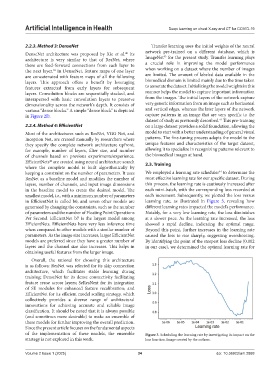
            keeping a constraint on the number of parameters. It uses   We employed a learning rate scheduler  to determine the
            ResNet as a baseline model and modifies the number of   most effective learning rate for our specific dataset. During
            layers, number of channels, and input image dimensions   this process, the learning rate is cautiously increased after
            in  the  baseline  model  to  create  the  desired  model.  The   each mini-batch, with the corresponding loss recorded at
            smallest model, i.e., with a minimum number of parameters   each increment. Subsequently, we plotted the loss versus
            in EfficientNet is called b0, and seven other models are   learning rate, as illustrated in  Figure  3, revealing how
            generated by changing the constraints, such as the number   different learning rates impacted the model’s performance.
            of parameters and the number of Floating Point Operations   Notably, for a very low learning rate, the loss diminishes
            Per Second. EfficientNet b7 is the largest model among   at a slower pace. As the learning rate increased, the loss
            EfficientNets. EfficientNets have very less inference time   showed  a  rapid  decline,  indicating  the  optimal  range.
            when compared to other models with a similar number of   Beyond this point, further increases in the learning rate
            parameters. As the image size increases, larger EfficientNet   caused the loss to rise sharply, suggesting overshooting.
            models are preferred since they have a greater number of   By identifying the point of the steepest loss decline (0.002
            layers and the channel size also increases. This helps in   in our case), we determined the optimal learning rate for
            obtaining useful features from the larger image.
              Overall, the rational for choosing this architecture
            is as follows: ResNet was selected for its skip connection
            architecture, which facilitates stable learning during
            training; DenseNet for its dense connectivity facilitating
            feature reuse across layers; SeResNext for its integration
            of SE modules for enhanced feature recalibration; and
            EfficientNet for its efficient model scaling strategy, which
            collectively provides a diverse range of architectural
            innovations for achieving accurate and reliable image
            classification. It should be noted that it is always possible
            (and sometimes more desirable) to make an ensemble of
            these models for further improving the overall prediction.
            Since the present article focuses on the fundamental aspects
            of  the  implementation  of  these  models,  the  ensemble   Figure 3. Scheduling the learning rate by investigating its impact on the
            strategy is not explored in this work.             loss function. Image created by the authors.


            Volume 2 Issue 1 (2025)                         34                               doi: 10.36922/aih.2888

