


Page 43 - AIH-2-1
P. 43
Artificial Intelligence in Health                            Deep learning on chest X-ray and CT for COVID-19


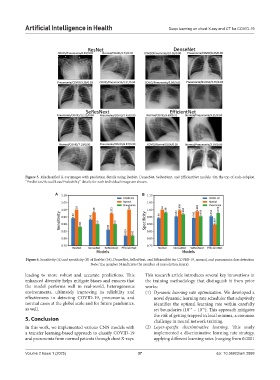
            Figure 5. Misclassified X-ray images with prediction details using ResNet, DenseNet, SeResNext, and EfficientNet models. On the top of each subplot,
            “Prediction/Actual/Loss/Probability” details for each individual image are shown.

                         A                                   B


            Figure 6. Sensitivity (A) and specificity (B) of ResNet (34), DenseNet, SeResNext, and EfficientNet for COVID-19, normal, and pneumonia class detection
                                        Note: The number 34 indicates the number of convolution layers).
            leading to more robust and accurate predictions. This   This research article introduces several key innovations in
            enhanced diversity helps mitigate biases and ensures that   the  training  methodology  that  distinguish  it  from  prior
            the model performs well in real-world, heterogeneous   works:
            environments, ultimately improving its reliability and   (1)  Dynamic learning rate optimization. We developed a
            effectiveness in detecting COVID-19, pneumonia, and   novel dynamic learning rate scheduler that adaptively
            normal cases at the global scale and for future pandemics,   identifies the optimal learning rate within carefully
            as well.                                              set boundaries (10  – 10 ). This approach mitigates
                                                                                 −4
                                                                                       −5
                                                                  the risk of getting trapped in local minima, a common
            5. Conclusion                                         challenge in neural network training.
            In this work, we implemented various CNN models with   (2)  Layer-specific discriminative learning. This study
            a transfer learning-based approach to classify COVID-19   implemented a discriminative learning rate strategy,
            and pneumonia from normal patients through chest X-rays.   applying different learning rates (ranging from 0.0001


            Volume 2 Issue 1 (2025)                         37                               doi: 10.36922/aih.2888

