


Page 117 - AIH-2-2
P. 117
Artificial Intelligence in Health                                 AI in early breast cancer diagnosis: A review


              Computer-aided early diagnosis of breast cancer has   technique of mitotic cells in blood as cancer biomarkers.
                                                                                                            20
            become a pivotal area of research, leveraging advancements   The study reported varying precision metrics on different
            in ML and DL to enhance diagnostic accuracy and early   datasets.
            intervention. Traditional detection methods, such as   Sharifi  et al.  analyzed two microarray datasets
                                                                             34
            mammograms, have been significantly improved by ML   (GSE106817 and GSE113486) to investigate miRNAs in the
            algorithms that can identify subtle changes in breast tissue   serum of breast cancer patients and healthy individuals.
                                                                                                            34
            indicative of cancer, even before tumors are visible on   The study identified the combined occurrence of miR-
            mammograms.                                        92a-3p, miR-23b-3p, and miR-191-5p was the most
              Various ML techniques, including SVM, kNN, and   promising pattern to distinguish breast cancer patients
            Naïve Bayes, have shown high accuracy in classifying breast   from healthy controls with 0.89 sensitivity, 0.96 specificity,
            cancer, with SVM achieving up to 98.24% accuracy.  DL   and an area under the curve (AUC) of 0.98. These
                                                      21
            models, especially CNNs, have further advanced this field   miRNAs represent new biomarkers for early detection of
            by automatically extracting features from mammogram   breast cancer. Kim et al.  studied miRNAs from tumor-
                                                                                   35
            images, achieving training accuracies up to 99% and   derived extracellular vesicles (EVs).  The study reported
                                                                                            35
            validation accuracies up to 96%.  The integration of CAD   the fabrication of a novel microfluidic device that can
                                      22
            systems utilizing these ML and DL models has proven   promptly and selectively separate cancerous EVs. Among
            effective in assisting radiologists by providing a second   the  candidate  miRNAs  studied  from  these  EVs,  four
            opinion, thus reducing false positives and negatives. 21  miRNAs  (miR‐9,  miR‐16,  miR‐21,  and miR‐429)  were
                                                               elevated in early‐stage breast cancer patients as opposed
              Despite these advancements, challenges such as   to healthy individuals, exhibiting high sensitivities of 0.90,
            overfitting in CNNs and the need for standardized data   0.86, 0.88, and 0.84 in each subtype of early‐stage breast
            collection and  analysis processes persist. Overall, the   cancer. This proposed methodology not only diagnosed
            integration of AI in breast cancer detection not only   early-stage breast cancer but also determined the cancer
            enhances early diagnosis but also supports clinical   subtype.
            decision-making, potentially saving countless lives by
                                                                         37
            enabling timely and accurate treatment.              Lin et al.  studied levels of circular RNA (circRNA) in
                                                               259 samples (144 breast cancer patients and 115 controls)
            3.2.2. Early breast cancer diagnosis by biomarkers   and developed classifiers from 20 candidate circRNA with
            obtained from LB                                   elevated levels, achieving an AUC of 0.83. The significance
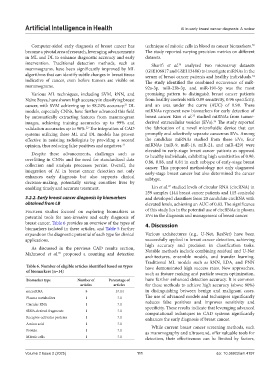
            Fourteen studies focused on exploring biomarkers as   of this study lies in the potential use of circRNAs in plasma
            potential tools for non-invasive and early diagnosis of   EVs in the diagnosis and management of breast cancer.
            breast cancer. Table 6 provides an overview of the types of   4. Discussion
            biomarkers isolated in these articles, and Table 5 further
            expands on the diagnostic potential of each type for clinical   Various architectures (e.g., U-Net, ResNet) have been
            applications.                                      successfully applied in breast cancer detection, achieving
                                                               high accuracy and precision in classification tasks.
              As discussed in the previous CAD results section,
            Mahmood  et al.  proposed a counting and detection   Notable methods include combining residual and U-Net
                          20
                                                               architectures,  ensemble  models,  and  transfer  learning.
                                                               Traditional ML models such as kNN, LDA, and PNN
            Table 6. Number of eligible articles identified based on types   have demonstrated high success rates. New approaches,
            of biomarkers (n=14)                               such as feature ranking and particle swarm optimization,
            Biomarker type        Number of    Percentage of   have further enhanced detection accuracy. It is common
                                   articles      articles      for these methods to achieve high accuracy (above 90%)
            microRNA                 8            57.14        in distinguishing between benign and malignant cases.
            Plasma metabolites       1             7.1         The use of advanced models and techniques significantly
            Circular RNA             1             7.1         reduces false positives and improves sensitivity and
                                                               specificity. These results indicate that leveraging advanced
            tRNA-derived fragments   1             7.1
                                                               computational techniques in CAD systems significantly
            Receptor-activator proteins  1         7.1         enhances the early diagnosis of breast cancer.
            Amino acid               1             7.1           While current breast cancer screening methods, such
            Protein                  1             7.1         as mammography and ultrasound, offer valuable tools for
            Mitotic cells            1             7.1         detection, their effectiveness can be limited by factors,


            Volume 2 Issue 2 (2025)                        111                               doi: 10.36922/aih.4197

