


Page 113 - AIH-2-2
P. 113
Artificial Intelligence in Health                                 AI in early breast cancer diagnosis: A review


            Table 3. (Continued)
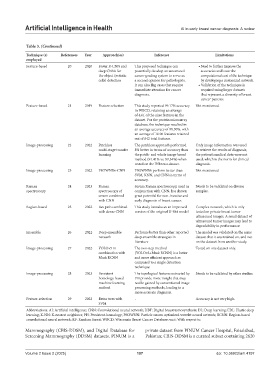
            Technique (s)   References  Year  Approach(es)         Inference                 Limitations
            employed
            Feature-based     20     2020  Faster R-CNN and   This proposed technique can   •  Need to further improve the
                                           deep CNNs for   potentially develop an automated   accuracies and lower the
                                           the object (mitotic   cancer grading system to serve as   computational cost of the technique
                                           cells) detection  a second opinion for pathologists.   by developing a customized network.
                                                          It can also flag cases that require   •  Validation of the technique is
                                                          immediate attention for cancer   required using larger datasets
                                                          diagnosis.                  that represent a diversity of breast
                                                                                      cancer patients.
            Feature-based     21     2019  Feature selection  This study reported 99.17% accuracy   Not mentioned.
                                                          in WBCD, retaining an average
                                                          of 4.61 of the nine features in the
                                                          dataset. For the protein microarray
                                                          database, the technique resulted in
                                                          an average accuracy of 98.30%, with
                                                          an average of 16.96 features retained
                                                          out of 642 total features.
            Image-processing  22     2022  Patchless      The patchless approach performed   Only image information was used
                                           multi-stage transfer   8% better in terms of accuracy than   to retrieve the results of diagnosis;
                                           learning       the patch- and whole image-based   the patient’s medical data were not
                                                          method (91.41% vs. 99.34%) when   used, which is the norm for clinical
                                                          tested on the INbreast dataset.  diagnosis.
            Image-processing  23     2022  PSOWNNs-CNN    PSOWNNs perform better than   Not mentioned
                                                          SVM, KNN, and CNN in terms of
                                                          accuracy.
            Raman             24     2023  Raman          Serum Raman spectroscopy, used in   Needs to be validated on diverse
            spectroscopy                   spectroscopy of   conjunction with CNN, has shown   samples.
                                           serum combined   great potential for non-invasive and
                                           with CNN       early diagnosis of breast cancer.
            Region-based      25     2022  Res path combined   This study introduces an improved   Complex network, which is only
                                           with dense CNN  version of the original U-Net model  tested on private breast tumor
                                                                                    ultrasound images. A small dataset of
                                                                                    ultrasound tumor images may lead to
                                                                                    degradability in performance.
            Ensemble          26     2022  Deep ensemble   Performs better than other reported   The model was validated on the same
                                           network        deep ensemble strategies in   dataset that it was trained on, and not
                                                          literature                on the dataset from another study.
            Image-processing  27     2022  YOLOv5 in      The two-step method       Tested on one dataset only.
                                           combination with   (YOLOv5+Mask RCNN) is a better
                                           Mask RCNN      and more efficient approach as
                                                          compared to a single detection
                                                          technique.
            Image-processing  28     2023  Persistent     The topological features extracted by   Needs to be validated by other studies.
                                           homology-based   PH provide more insight that may
                                           machine learning   not be gained by conventional image
                                           method         processing methods, leading to a
                                                          more accurate diagnosis.
            Feature-selection  29    2022  Extra trees with   -                     Accuracy is not very high.
                                           SVM
            Abbreviations: AI: Artificial intelligence; CNN: Convolutional neural network; DBT: Digital breast tomosynthesis; DL: Deep learning; EDL: Elastic deep
            learning; K-NN: K-nearest neighbors; PH: Persistent-homology; PSOWNN: Particle swarm optimized wavelet neural network; RCNN: Region-based
            convolutional neural network; RF: Random forest; WBCD: Wisconsin Breast Cancer Database; w.r.t: With respect to.

            Mammography (CBIS-DDSM), and Digital Database for   private dataset from PINUM Cancer Hospital, Faisalabad,
            Screening Mammography (DDSM) datasets. PINUM is a   Pakistan; CBIS-DDSM is a curated subset containing 2620


            Volume 2 Issue 2 (2025)                        107                               doi: 10.36922/aih.4197

