


Page 110 - AIH-2-2
P. 110
Artificial Intelligence in Health                                 AI in early breast cancer diagnosis: A review


            2.3. Cancer biomarkers obtained from liquid biopsy   necrotic tumor cells. When derived from tumors, it is
            (LB)                                               known as circulating tumor DNA (ctDNA). CtDNA can
            LB is emerging as a revolutionary, non-invasive technique   carry mutations, copy number variations, and methylation
            for the timely diagnosis and management of breast   changes characteristic of cancer. Using high-throughput
            cancer.  Unlike traditional tissue biopsies, liquid biopsies   sequencing  technologies,  these  genetic  alterations  can
                 6
            analyze biomarkers found in body fluids such as blood,   be  detected  and  monitored  over  time.  CtDNA  analysis
            urine, or saliva. This method holds significant potential   is particularly valuable for detecting minimal residual
            for  expediting  early  detection,  monitoring  treatment   disease and monitoring treatment responses, providing a
            responses, and understanding the molecular dynamics   dynamic picture of the tumor’s genetic profile. 14
            of breast cancer.  LB involves detecting the presence and   MicroRNAs, as the name implies, are small RNA
                         6
            molecular analysis of  CTCs, cell-free  DNA (cfDNA),   molecules involved in the regulation of gene expression.
            and other biomolecules such as proteins and miRNAs in   Certain miRNAs are expressed in cancer patients and
            the blood. These components are shed from the primary   can serve as biomarkers for early detection. In addition,
            tumor into the bloodstream, providing real-time insights   protein  biomarkers,  such  as  cancer  antigen  15-3  and
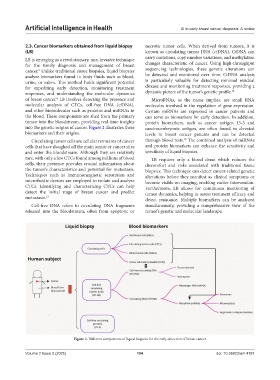
            into the genetic origins of cancer. Figure 2 illustrates these   carcinoembryonic antigen, are often found in elevated
            biomarkers and their origins.                      levels in breast cancer patients and can be detected
                                                                               15
              Circulating tumor cells are cellular remnants of cancer   through blood tests.  The combined analysis of miRNAs
            cells that have sloughed off the main tumor or cancer sites   and protein biomarkers can enhance the sensitivity and
            and enter the bloodstream. Although they are relatively   specificity of liquid biopsies.
            rare, with only a few CTCs found among millions of blood   LB requires only a blood draw, which reduces the
            cells, their presence provides crucial information about   discomfort and risks associated with traditional tissue
            the tumor’s characteristics and potential for metastasis.   biopsies. This technique can detect cancer-related genetic
            Techniques such as immunomagnetic separation and   alterations before they manifest as clinical symptoms or
            microfluidic devices are employed to isolate and analyze   become visible on imaging, enabling earlier intervention.
            CTCs. Identifying and characterizing CTCs can help   Furthermore, LB allows for continuous monitoring of
            detect the initial stage of breast cancer and predict   tumor dynamics, helping to assess treatment efficacy and
            metastasis. 13                                     detect resistance. Multiple biomarkers can be analyzed
              Cell-free DNA  refers to circulating DNA  fragments   simultaneously, providing a comprehensive view of the
            released  into  the  bloodstream,  often  from  apoptotic  or   tumor’s genetic and molecular landscape.


                                Figure 2. Different components of liquid biopsies for the early detection of breast cancer


            Volume 2 Issue 2 (2025)                        104                               doi: 10.36922/aih.4197

