


Page 111 - AIH-2-2
P. 111
Artificial Intelligence in Health                                 AI in early breast cancer diagnosis: A review


            3. Systematic literature review                    a lack of focus on early detection methods, classification
                                                               as questionnaires, review articles, or meta-analyses rather
            3.1. Methods                                       than primary research.
            This literature review was drafted according to the
            Preferred Reporting Items for Systematic Reviews and   3.2. Results
            Meta-Analyses (PRISMA) guidelines. A digital search was   Out of 26 studies finalized, 13 articles focused on early
            conducted using standard terms and keywords in PubMed,   detection of breast cancer by implementing AI in imaging
            along with the application of AND/OR operators for highly   modalities. The remaining 13 studies were focused on
            specific results, ACM Digital Library, and SciSpace. The   cancer biomarkers obtained through LB, which have the
            search spanned from February to April 2024, and the query   potential to revolutionize early diagnosis of breast cancer.
            results were saved to Zotero. Duplicates among the saved
            searches  were  manually  scanned  and  removed.  In  total,   3.2.1. Early detection of breast cancer by AI
            192 articles were identified and assessed for language, title,   implementation in computer-aided detection
            abstract, date of publication, and type of work. Full-text   Tables 3 and 4 provide a comprehensive overview of studies
            screening further narrowed down the results for exclusion,   focused on implementing AI models with CAD to improve
            and the remaining studies were screened for full-text   the diagnostic accuracy of breast cancer.
            access. This step was performed by a single reviewer.
                                                                 Thirteen articles investigated the use of AI with CAD
              This study adheres to the PRISMA 2020 statement.   to improve the diagnostic accuracy of breast cancer across
            Exclusion/inclusion was based on the criteria defined   various medical imaging modalities such as ultrasound,
            below.                                             mammography, and histopathology images. Nine articles

              Studies included in this study must involve human   implemented CAD systems with DL models and four
            participants, specifically focusing on the female population   reports utilized ML models to establish a diagnostic
            within the age range of 18 – 65  years or older. Eligible   model to assist clinicians. Table 5 expands on the model
            studies included those with patients diagnosed with breast   performance metrics developed in each study.
            cancer confirmed by medical examination and healthy   Mahmood  et al.   used  a  novel  approach  to detect
                                                                               20
            controls with no history of cancer. Inclusion criteria   mitosis in histopathology images by designing a
            require clear reporting of sensitivity, total number of cases,   combination of Resnet-50 and a dense convolutional
            and a description of case derivation, with blood samples   network (Densenet)-201, achieving a precision of 87.6%.
            collected for analysis before any treatment. Comprehensive   The datasets used were the International Conference
            data extraction was mandated, including patient ethnicity,   on Pattern Recognition (ICPR)  2012, with 50 high-
            detection methods, and accurate diagnostic figures (true   power field images from five different slides, ICPR 2014,
            positives, false positives, false negatives, and true negatives).   with 1,696 frames from 73  patients, and the Tumor
            Exclusion criteria encompassed duplicate publications,   Proliferation Assessment Challenge 16, which comprised
            articles with insufficient data, meeting abstracts, review   821 image regions from 73 breast cancer cases. Jignesh
            articles, meta-analyses, and questionnaires or knowledge   Chowdary  et  al.  worked with ultrasound images to
                                                                             17
            surveys.                                           develop systematized segmentation and classification
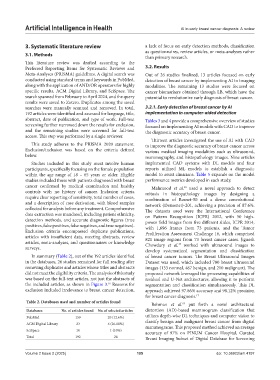
              In summary (Table 2), out of the 192 articles identified   of breast cancer tumors. The Breast Ultrasound Images
            in the databases, 26 studies remained for full reading after   Dataset was used, which included 780 breast ultrasound
            removing duplicates and articles whose titles and abstracts   images (133 normal, 487 benign, and 210 malignant). The
            did not meet the eligibility criteria. The analysis of this study   proposed network leveraged the processing capabilities of
            was based on the full-text articles, not just the abstracts of   residual and U-Net architectures, allowing it to perform
            the included articles, as shown in Figure 3.  Reasons for   segmentation and classification simultaneously. This DL
                                               16
            exclusion included irrelevance to breast cancer detection,   approach achieved 97.86% accuracy and 98.12% precision
                                                               for breast cancer diagnosis. 17
            Table 2. Databases used and number of articles found
                                                                 Rehman  et al.  put forth a novel architectural
                                                                               18
            Databases      No. of articles found  No. of selected articles  distortion (AD)-based mammogram classification that
            PubMed               159           20 (12.6%)      utilizes depth-wise DL techniques and computer vision to
                                                               classify benign and malignant breast cancer from digital
            ACM Digital Library  23            6 (26.08%)      mammograms. This proposed method achieved an average
            SciSpace             10             1 (10%)        accuracy  of  97%  on  PINUM  Cancer  Hospital,  Curated
            Total                192              26           Breast Imaging Subset of Digital Database for Screening


            Volume 2 Issue 2 (2025)                        105                               doi: 10.36922/aih.4197

