


Page 109 - AIH-2-2
P. 109
Artificial Intelligence in Health                                 AI in early breast cancer diagnosis: A review


            Traditional diagnostic methods, such as the ones discussed   shape, texture, and edge information. Advanced
            above, namely mammography, ultrasound, and MRI, have    feature extraction methods, such as wavelet
            significantly contributed to early detection.  However,   transforms and texture analysis, are employed to
                                                 10
            these methods have limitations, including variability in   capture intricate details within the images.
            interpretation among radiologists, which can lead to missed   (iii)  Classification: Classification is a fundamental aspect
            diagnoses or false positives. CAD systems offer a promising   of ML, and these algorithms play a pivotal role in
            solution to enhance the accuracy and consistency of early   CAD systems. Supervised ML techniques, such as
            detection. CAD systems are devised to help radiologists   neural networks, support vector machines (SVM),
            interpret medical images by highlighting potentially    and DL models, are trained on large datasets of
            cancerous  areas that may  require  further  examination.   labeled images to classify regions of interest as either
            These  systems  use  complex  algorithms  combined  with   benign or malignant. These algorithms learn from
            advanced ML techniques to analyze medical images,       both seen and unseen data, continuously evolving to
            such as mammograms, and identify patterns that indicate   improve their accuracy over time.
            malignancy. The primary goal of CAD in breast cancer   (iv)  Detection and localization: The CAD system identifies
            detection is to improve diagnostic accuracy, reduce human   and localizes suspicious areas within the breast
            error, and increase the likelihood of early detection.  tissue by marking these regions on the images. This
                                                                    functionality provides radiologists with visual cues to
            2.2.1. Key components of computer-aided detection       focus their attention on potential abnormalities. This
            systems
                                                                    step is crucial for ensuring that no suspicious area is
            Computer-aided detection systems rely on a series of key   overlooked during the diagnostic process.
            components that work together to analyze medical images
            and assist in the accurate detection of abnormalities.   Computer-aided detection systems can analyze
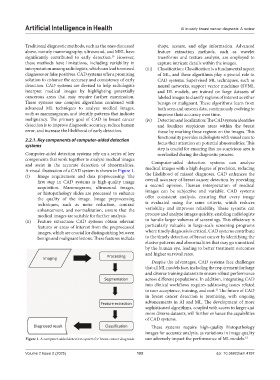
            A visual illustration of a CAD system is shown in Figure 1.  medical images with a high degree of precision, reducing
            (i)   Image acquirement and data preprocessing: The   the likelihood of missed diagnoses. CAD enhances the
                 first step in CAD systems is high-quality image   overall accuracy of breast cancer detection by providing
                 acquisition. Mammograms, ultrasound images,   a second opinion. Human interpretation of medical
                 or histopathology slides are processed to enhance   images can be subjective and variable. CAD systems
                 the quality of the image. Image preprocessing   offer consistent analysis, ensuring that every image
                 techniques, such as noise reduction, contrast   is evaluated using the same criteria, which reduces
                 enhancement, and normalization, ensure that the   variability and improves reliability. These systems can
                 medical images are suitable for further analysis.  process and analyze images quickly, enabling radiologists
            (ii)   Feature  extraction:  CAD  systems  obtain  relevant   to handle larger volumes of screenings. This efficiency is
                 features or areas of interest from the preprocessed   particularly valuable in large-scale screening programs
                 images, which are crucial for distinguishing between   where timely diagnosis is critical. CAD systems contribute
                 benign and malignant lesions. These features include   to the timely detection of breast cancer by identifying the
                                                               elusive patterns and abnormalities that may go unnoticed
                                                               by the human eye, leading to better treatment outcomes
                                                               and higher survival rates.
                                                                 Despite the advantages, CAD systems face challenges
                                                               that all ML models face, including the requirement for large
                                                               and diverse training datasets to ensure robust performance
                                                               across different populations. In addition, integrating CAD
                                                               into clinical workflows requires addressing issues related
                                                               to user acceptance, training, and cost.  The future of CAD
                                                                                             11
                                                               in breast cancer detection is promising, with ongoing
                                                               advancements in AI and ML. The development of more
                                                               sophisticated algorithms, coupled with access to larger and
                                                               more diverse datasets, will further enhance the capabilities
                                                               of CAD systems.
                                                                 These systems require high-quality histopathology
                                                               images for accurate analysis, as variations in image quality
            Figure 1. A computer-aided detection system for breast cancer diagnosis  can adversely impact the performance of ML models. 12


            Volume 2 Issue 2 (2025)                        103                               doi: 10.36922/aih.4197

